

Welcome: this guide helps you download and play a simple version of this melody. It is intended for beginners and intermediate players who want to improve step by step.
Goal: introduce the recommended instrument (preferably a 12-hole ocarina in C), provide a learning plan, and explain where to find the files. You will also find guidance on using a metronome, fingering, and breathing.
The community page sometimes asks you to sign in before rating or commenting. You will see difficulty levels (Very Easy, Intermediate) and examples of posts that have received likes.
This tutorial draws on “Intermediate” versions to create a simple arrangement while staying true to the original melody. The plan covers choosing an instrument, reading the notation, practicing the rhythm, and connecting the phrases.
As you work through the sections, learn to read the sheet music, develop good habits, and interact with the community to get useful feedback.
Background, sheet music, and official references for Sun’s Song
This theme is part of the world of The Legend of Zelda. It was composed by Koji Kondo for The Legend of Zelda: Ocarina of Time, released in 1997. In the game, the tune acts as a musical cue for the transition between day and night.
Origins and original title
Remember the original title Song of Sun to identify the right entry when a site uses English. The composer and date (Koji Kondo, 1997) are useful references for checking a listing’s authenticity.
Where to find files and useful examples
Go to the category: Sheet Music > Video Games > The Legend of Zelda > Sun’s Song (the exact capitalization may vary between sites).
- Example: C Intermediate 12-hole (created by “cocothebest,” unlisted entry, 1 like).
- Another entry: C Intermediate Double Triple (by “Rinku,” public, 2 likes).
Note that Public or Unlisted status changes an entry’s visibility. Create an account to rate or comment, and keep your references (categories, authors, formats) together so you can quickly find your chosen sheet music again.
Step-by-step tutorial: Easy Sun’s Song ocarina sheet music
Begin this tutorial by choosing a suitable instrument to build confidence as you learn.
Choosing your ocarina
Choose a 12-hole ocarina in C for an easy introduction. Double or triple models can be useful if you have already mastered some ornamentation, but use the 12-hole model for the main melody.
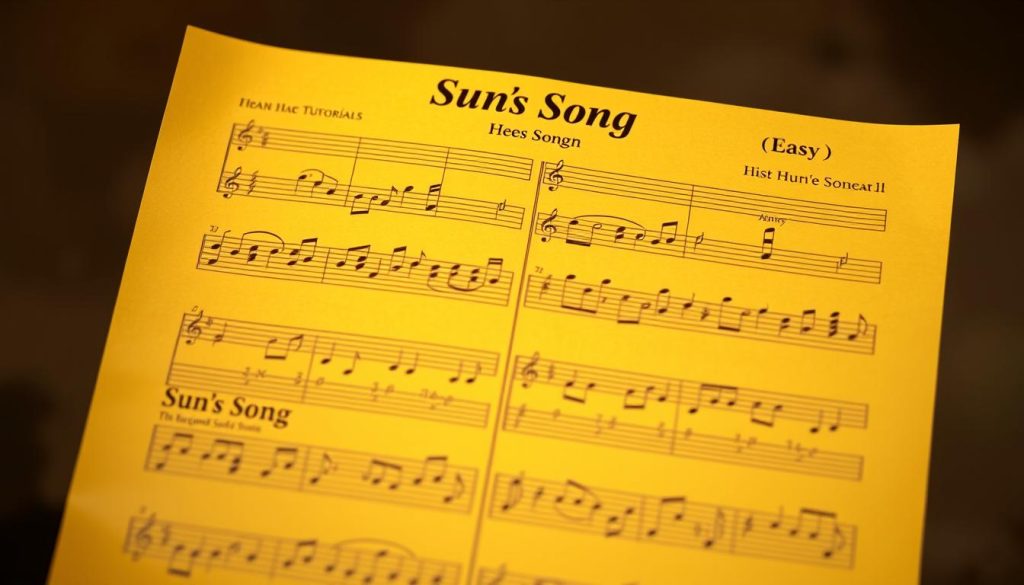
Reading the sheet music and tablature
Identify the key and range, then mark the main reference notes in pencil. With the tablature, settle on consistent basic fingerings before adding slurs.
Breaking down the melody and managing your breath
Divide the melody into short call-and-response phrases. Take brief breaths at the end of each phrase to keep the melodic line flowing.
Tempo and progress
Practice with a metronome: start slowly, then increase the tempo in 5 BPM steps. Keep your articulation gentle and your pitch steady at each step.
Using “Intermediate” versions as references
Refer to the C Intermediate 12-hole or Double/Triple entries to simplify the melody. Remove ornaments, hold longer notes, and bring the range back within that of the 12-hole model.
Downloading and annotating
Download and print the sheet music. Mark difficult fingerings, add arrows for breathing, and highlight transitions. Repeat tricky connections 5 to 10 times before putting them back into the piece.
“Musical expression matters more than speed: take time to listen to each phrase.”
Practice tips and community: improving your performance
To improve your performance, work on your technique and consider feedback. Use short, focused routines to practice breathing, articulation, and posture. These directly affect the pitch and clarity of each phrase.
Common mistakes to avoid
Avoid excessive air pressure. Blowing too hard affects the instrument’s pitch. Use a steady, relaxed breath for accurate intonation.
Watch your hand position. Fingers that are too flat or lifted too high let air escape. Cover the holes without tensing up.
Pay attention to how you start each note while practicing with a metronome. Begin gently, then work on slurs to make the melodic line flow.
Finally, keep your breaths discreet: place them at the ends of phrases and practice inhaling quickly and quietly.
Making use of the community: liking, rating, and commenting
Sign in to like, rate, and comment. Likes and ratings help you identify dependable versions, but read the feedback too for practical advice.
- Compare several versions in the same category to choose the approach that suits you best.
- Share your recordings and sheet-music annotations to get specific advice.
- Keep a practice log of your tempos and the passages you have corrected.
“Ask for specific feedback (pitch, fingering, rhythm) and thank the contributors who help you.”
Conclusion
To finish, keep the key stages of your learning in mind.
Origin: this theme was composed by Koji Kondo for Ocarina of Time (1997). This reference helps you maintain a clear, expressive musical intention.
You now have a framework for playing a simplified version of the melody: instrument choice, reading the music, phrasing, tempo, and simplification using the C Intermediate references (12-hole, Double, Triple).
Go to the relevant categories (Sheet Music > Video Games > The Legend of Zelda > Sun’s Song) to find the score. Compare several sources before setting your practice plan.
Focus on tone quality, accurate pitch, and controlled breathing before increasing your speed. Record your progress and ask for feedback by signing in to like, rate, and comment.
If you get stuck, return to practicing phrase by phrase with a metronome: that is the key to lasting progress. Once you have mastered the simple version, enrich your performance with elements from the C Intermediate versions.