
Why choose this instrument today? This guide shows you how to select a model, expand your repertoire, and master the basics so you can play with confidence.
What you will learn: how to check your ocarina’s note range, choose suitable sheet music, and structure your practice step by step.
In general, a 12-hole model covers a little more than one octave, sometimes up to 1.6 octaves depending on its shape and number of holes. That is enough to explore a variety of world music.
For example, a soprano advertised as covering A5–F7 can play many melodies, provided you account for accidentals.
Method: always compare the written notes with those your instrument can produce before learning a song.
This article is organized into clear sections: understanding the instrument, reading sheet music and tablature, working on breath control and fingering, and exploring a practical repertoire that increases in difficulty.
Understanding the 12-hole ocarina today: range, key, and shapes
The number of openings and the instrument’s construction determine its actual range. The internal volume and the size of the holes affect pitch and response to breath. Smaller instruments produce higher notes and require less breath.
Number of holes and range: on a standard model, expect approximately 1 to 1.6 octaves, depending on the number of holes and the size. Multichamber models extend the range and let you play harmonies or add a drone.
Materials and shapes: plastic (durable), ceramic (traditional, with less condensation), wood (warm sounding), and metal (sturdy). Shapes range from pendants to inline models and transverse “sweet potato” ocarinas. Whether an instrument points right or left affects comfort for left-handed and right-handed players.
| Material | Advantage | Drawback |
|---|---|---|
| Plastic | Durable, affordable | Possible condensation |
| Ceramic | Consistent sound, attractive appearance | Fragile |
| Wood | Warm tone | Sensitive to humidity |
| Metal | Sturdy | Expensive; condensation |
Common keys: C, F, and G are the most widespread. For less common models, check the manufacturer’s specifications (for example, A5–F7) before buying.
12-Hole Ocarina: Repertoire and Techniques
Overview — A structured approach helps you progress quickly. Start with simple tablature, move on to combined notation and fingering charts, and then use full sheet music to play more independently.

Reading sheet music is learned in stages. Tablature shows which holes to cover; sheet music requires some knowledge of notation to understand rhythms and slurs.
- Memorizing the fingerings for key notes makes it easier to read as you play.
- Choosing an ocarina in C gives you access to the widest selection of music for this instrument.
- Checking the range helps you avoid passages beyond your instrument’s notes and unnecessary transposition.
Structure your practice: work slowly on fingering, control your breath and volume, then gradually increase the tempo.
| Stage | Goal | Suggested time |
|---|---|---|
| Simple tablature | Play a melody quickly | 2 to 3 weeks |
| Combined notation and fingering charts | Connect fingerings with written notes | 3 to 4 weeks |
| Sheet music | Play independently | 4 weeks or more |
Reading ocarina sheet music and tablature: from the staff to fingering charts
Understanding how written notes relate to fingering charts speeds up your progress.
Simple tablature: each diagram represents one note. Black holes are covered; white holes are open. Read from top to bottom, then from left to right.
Dashes extend a note’s duration. Braces indicate notes to play in one breath. Vertical lines mark possible places to breathe.
Standard sheet music: identify the treble clef, key signature, and time signature. Recognize note values (whole, half, quarter, and eighth notes) and rests.
“Compare one quarter note with two eighth notes to check your rhythmic emphasis.”
- Learn the symbols: slurs, augmentation dots, and triplets.
- Combined notation and fingering charts put written notes and diagrams together, helping you connect notation with fingerings.
- Check playability: compare the piece’s notes with your instrument’s range before choosing the music.
| Topic | Key point | Action |
|---|---|---|
| Notation | Clef, key signature, note values | Read slowly |
| Fingering | Diagrams and note positions | Learn the pattern |
| Key | Transposition | Adapt the fingering |
Tip: play slowly and count aloud, then increase the tempo while staying in tune.
Essential playing techniques: breath, articulation, and slurs on a 12-hole ocarina
Controlling airflow is the key to a clear, steady note.
Breath and volume: adjust your breathing to the instrument’s range. Higher-pitched instruments need less breath than lower-pitched ones. Keep the airflow steady to stabilize pitch and tone.
Breath and phrasing
Use the slurs marked by braces to play several notes in one breath. This requires good breath capacity and precise fingering.
Articulation and expression
Vary the attack (“ta” or “da”) to add character. Slurs smooth the melodic line; clear articulation gives the phrase structure.
“Keeping the airflow steady prevents fluctuations in pitch and produces an even note.”
Exercises and multichamber ocarinas
Practice ascending and descending sequences with a metronome. Work on semitones and leaps, starting slowly.
| Type | Characteristic | Musical effect |
|---|---|---|
| Vicinelli | No overlap | Wide overall range |
| Pacchioni | Small overlap | Smoother transitions between chambers |
| Multichamber (double) | Two playable chambers | Harmony or a drone is possible |
To learn more about breath support, see this practical guide: breathing and breath support.
Progressive repertoire for a 12-hole ocarina in C: classical music, world music, and games
Choosing pieces that suit the instrument’s range and key makes learning easier for beginners. Start with melodies that have a narrow range in C major or A minor. These choices reduce the number of accidentals and help establish consistent fingerings.
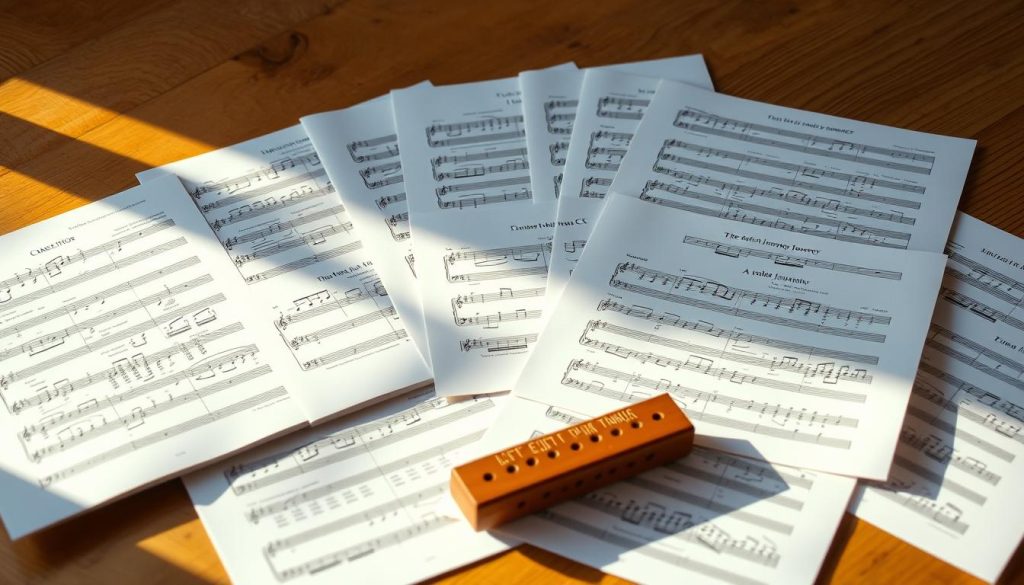
Simplified classical sheet music: choose Mozart or Beethoven arrangements adapted to your instrument’s range. Short classical pieces let you learn structure, phrasing, and rhythm without encountering notes beyond its range.
Popular music and music from other traditions: explore folk melodies from around the world that fit your instrument’s range. Watch for chromatic notes; if you cannot play every note, look for an arrangement in C.
Practical resource
The book “The Art of Ocarina: Volume 1” contains 12 lessons, more than 50 pieces, and 12 additional tracks. Follow the lessons to develop your playing gradually, and use the CD to check your intonation and tempo.
- Build a learning path: simple melodies → classical sheet music → world music.
- Alternate short practice sessions so you can play several pieces without tiring.
- Make a list of 3 to 5 pieces to practice regularly.
Conclusion
Always check the range before choosing sheet music. Compare the notes in the piece with the fingering chart supplied by the manufacturer. This helps you avoid surprises and makes learning easier.
Choose the right type and shape: a well-balanced sweet potato ocarina that points in a comfortable direction improves fingering and comfort. Pay attention to slurs marked by braces when planning your breaths.
Finally, alternate reading with playing. Add a new piece to your repertoire each week, and track your progress in intonation and phrasing to make the instrument part of your everyday music-making.