

Goal: provide a clear comparison between a closed vessel instrument and a set of pipes. This article helps you choose according to your playing habits, musical style, and preferred sound.
A brief history: Giuseppe Donati standardized early vessel-flute designs in nineteenth-century Budrio. Panpipes come from Andean traditions; each pipe produces a fixed pitch.
Acoustically, a Helmholtz resonator’s sound depends on air pressure and fingering. A pan flute instead uses pre-tuned pipes, with the player selecting the pipe for the desired note. Ergonomics, range, and cost differ considerably.
What to consider: shape, materials, number of holes or pipes, musical styles, availability, and price. Student models exist in both families, but their fragility and repairability differ.
For a broader overview, see this practical guide: detailed comparison.
Why compare the ocarina and pan flute today?
Renewed interest in these instruments reflects two forces: popular culture and living tradition. Media exposure has created an active online community, while Andean heritage remains present in performances and music education.
For beginners and experienced musicians alike, the choice affects the learning curve, comfort, and progress. Entry-level and intermediate instruments vary in price and quality, shaping long-term satisfaction.
Breath affects how each note is produced: one instrument requires fine control of air pressure, while the other calls for practicing the attack on each pipe. The learning environment—teachers, sheet music, and workshops—quickly influences the level a player can reach.
Everyday considerations also matter: maintenance, portability, and durability. Whether your goal is an intimate solo or a stage performance, the decision often comes down to two distinct ways of playing.
| Criterion | Community and resources | Breath control | Initial cost |
|---|---|---|---|
| Popular instrument | Extensive online tutorial resources | Very fine pressure control | Low to moderate |
| Traditional instrument | Local schools and workshops | Consistent attack on each pipe | Varies with the number of pipes |
| Uses | Solo playing, online communities | Dynamic precision | Choice depends on quality |
Quick definitions: two wind instruments, two families
One concentrates the energy of the breath in a chamber; the other distributes pitches among pipes.
Ocarina: vessel flute and Helmholtz resonator
This wind instrument is a small, egg-shaped resonator with a closed body. Its sound comes from air striking the labium after passing through a fipple-style mouthpiece. Pitch depends on the internal volume, open finger holes, and air pressure.
The Italian name evokes the shape of a little goose’s head. Vessel flutes include these rounded forms, which Giuseppe Donati standardized in the nineteenth century.
Pan flute: a set of tuned pipes
A pan flute consists of pipes of different lengths. Each pipe produces a fixed pitch. The player chooses which pipe to blow across, without fingering holes along the pipe.
Pan flutes are often made from bamboo or wood. Tuning depends on each pipe’s length and whether its end is stopped, so each pipe determines a pitch rather than one shared chamber.
| Feature | Vessel resonator | Set of pipes |
|---|---|---|
| Sound source | Closed cavity and labium | Individual air columns |
| Control | Opening finger holes and adjusting air pressure | Selecting which pipe to blow across |
| Common materials | Ceramic, clay, wood, plastic | Bamboo, wood, sometimes metal |
| Effect on range | Fingering changes the available pitches | Range depends on the number of pipes |
Shape and design: a rounded body and aligned pipes
An instrument’s shape guides the player’s movements and affects comfort. The vessel flute often has an egg-shaped body described as a “goose’s head,” concentrating resonance in a closed cavity.
Shapes vary by use: a transverse ocarina is held horizontally and often has 10 to 12 holes. Pendant versions are compact, with just 4 to 6 holes.
The pan flute, by contrast, brings together aligned pipes of increasing length. Their number and length determine its range. A comparison with the transverse flute makes the difference clear: a straight tube versus a rounded body.
- Grip: the vessel flute rests in the palms, while both hands cover the holes.
- Stability: the pan flute requires the player to hold the whole set of pipes and locate pitches across it.
- Fatigue: a heavy instrument strains the wrist; a large set of pipes works the forearm.
Acoustics: Helmholtz resonator and air columns
The physics of sound depends on how the instrument guides and moves air.
Each note and the role of the labium
A Helmholtz resonator is a closed cavity connected to the outside by a narrow opening. Air blown through the windway strikes the labium, exciting oscillation in the cavity.
Pitch depends on the effective volume and breath pressure. Too great a change in pressure can easily affect intonation.
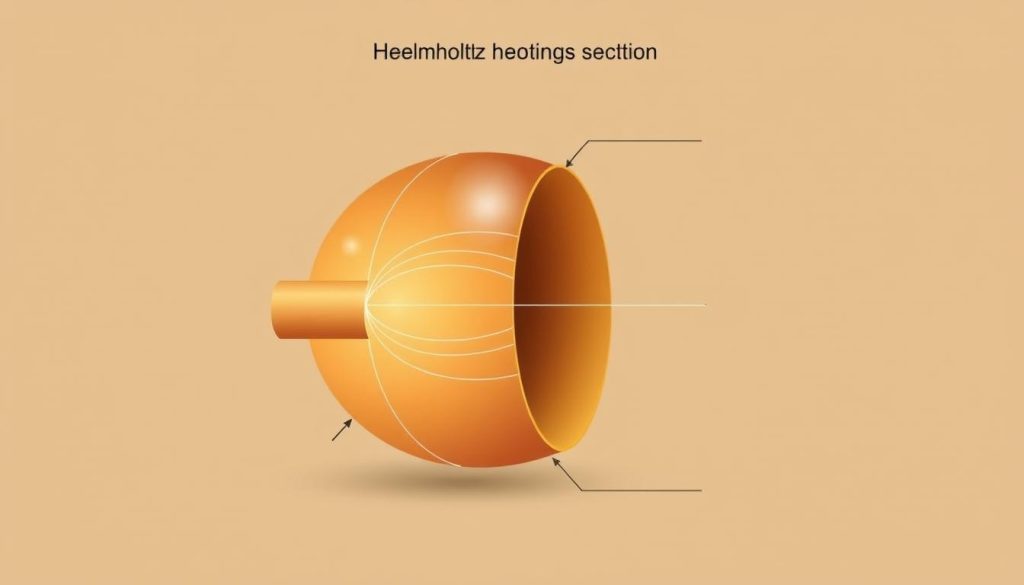
Each pipe forms a resonant air column
In a pan flute, each pipe contains an air column. Its length determines its frequency, and the player selects a pipe to blow across instead of opening finger holes.
The attack and the angle of the breath stabilize the tone. A consistent attack keeps intonation steadier than a change in pressure alone.
- Careful listening: the instrument demands attention to small adjustments in breath and its angle.
- Expressive scope: vibrato and varied attacks are possible, but the range remains limited unless you change instruments.
Number of holes and pipes: a direct effect on the notes
The number of openings or pipes makes a substantial difference. Finger holes determine range and the precision required for fingering. Pendants often have 4 to 6 holes, enough for about an octave.
Transverse models generally have 10 to 12 holes. They offer roughly 1.5 to 2 octaves and more harmonic possibilities.
Double- and triple-chamber models add mouthpieces and cavities. They extend the range without requiring the player to change instruments.
For a pan flute, range depends on the number of pipes: 13, 18, 22, or more. Each pipe adds one fixed note. More pipes expand the playable repertoire.
- Technique: more holes require precise finger placement and a good seal.
- Practicality: more pipes make the instrument heavier but reduce the need to transpose.
- Choice: choose a compact model if portability matters most; choose an extended version for versatility.
Range, scale, and intonation
An instrument’s range directly affects the repertoire and the player’s posture. Understanding the available pitches helps you choose for your musical needs and comfort.
Soprano, alto, tenor, and bass: ranges and ergonomics
High-pitched versions (soprano) are compact and easy to hold. They suit melodic playing and bright passages.
Middle registers (alto and tenor) offer a useful balance for melodies and accompaniment. Low-pitched models are larger and require a wider finger span.
Size, number of holes, and finger coverage
The playable scale depends on the number of holes and how carefully the maker positions and shapes them.
A pipe without finger holes produces a fixed note; an assembled set expands the available pitches according to its layout and diatonic or chromatic tuning.
Intonation: controlled breath and tuned pipes
“Every note requires precision”: in a vessel flute, pressure can quickly change pitch. In a pan flute, stability comes from accurately tuned pipes and a consistent attack.
Technical skill affects intonation: inexperience is especially noticeable in registers sensitive to breath pressure.
“Try several configurations to find the range you want and the comfort that supports accurate playing.”
Breath, embouchure, and hand comfort
Breath and mouthpiece shape largely determine how each instrument responds.
Controlling pressure for each note
The fipple-style mouthpiece directs the air and calls for a gentle, steady breath. Blowing too hard changes intonation and makes a note harder to sustain.
Tongue placement helps articulate clear attacks. Simple exercises using “ta” and “da” help stabilize pressure and coordination.
Attack and consistency from pipe to pipe
On a pan flute, the player blows across the rim of each pipe. Lip position and breath angle help keep the tone even across pitches.
Posture also matters: a stable hold prevents small variations and reduces forearm fatigue.
Hands, covering holes, and fatigue
Fingers must cover the holes without leaking air. A poor seal affects intonation and note production.
Fatigue causes pressure fluctuations and less accurate attacks. To address it, practice slow scales, airflow-control exercises, and short endurance sessions.
Tip: choose an instrument whose hole spacing fits your natural finger span, so you can progress without strain.
Materials and sound: ceramic, wood, plastic, and metal
Material shapes an instrument’s tone as well as its appearance. Understanding these effects helps players choose an instrument that suits their style and budget.
Ocarinas made from ceramic, clay, wood, or plastic
Ceramic and porcelain offer a smooth, precise sound and good projection, but they are fragile. Plastic ocarinas resist impacts, cost relatively little (€15 to €50), and suit travel; their tone tends to be drier.
Wood gives a warm, lively character. It needs care to withstand moisture and retain its tuning. Metal models are rare and produce a bright, high-pitched sound.
Bamboo, wood, and modern variations
For pan flutes, bamboo and wood provide a traditional character and warm sound. Modern versions may have protective finishes that improve durability and tuning stability.
- Shape and construction matter as much as material: the position of the holes and the cavity alter the tone color.
- Try several models to hear their differences and check how comfortably they fit your hands.
Tip: favor ceramic for precision, plastic for durability, and wood for character.
In short, material affects the quality and lifespan of your wind instrument; listen, compare, and choose for your intended use. For a fuller overview, consult a comparison guide.
Origins and history: from the Andes to Budrio
The history of these instruments spans millennia and several continents.
Ancient roots: vessel flutes appeared in prehistoric times, including in Latin America. Excavations have uncovered decorated pieces used in rituals or domestic music-making. These remains attest to a practice thousands of years old.
Nineteenth-century innovation: in 1853, Giuseppe Donati standardized the modern ten-hole version in Budrio. This made chromatic playing and larger-scale production easier. It also paved the way for dedicated ensembles and teaching methods.
Andean tradition: the set of pipes from the Andes spread through migration and cultural exchange. It remains emblematic of local music and now features in ensembles around the world.
Related historical context: transverse flutes originated in Asia before spreading through Europe by the ninth century. Recorders have been well documented since the fourteenth century.
Modern cultural impact: in the 1990s, the success of the video game The Legend of Zelda: Ocarina of Time introduced these instruments to a wider public. This resource explores their historical development.
“This rich history explains why today’s selection includes both traditional craftsmanship and industrial production.”
Ocarina vs. pan flute: key differences
Structure and the number of components define each instrument’s characteristics. One relies on a single cavity with carefully sized holes; the other brings together several individually tuned pipes.
Construction and tuning
A closed body produces pitches related to its internal volume. Its tuning is usually fixed; only a few rare versions can be adjusted.
A set of pipes can be tuned by changing the length of a pipe or how far it is stopped, making adjustment more flexible and sometimes allowing the instrument to be retuned.
Playing, fingering, and learning
Ocarina fingering requires precise coverage of the holes and careful breath control, note by note. Playing a pan flute instead calls for a consistent attack on each pipe and spatial coordination somewhat like that used for a transverse flute.
Portability, fragility, and repairability
The ocarina is compact but fragile, especially when made of ceramic; a break is often irreparable. A set of pipes, often made of bamboo or wood, can better withstand knocks and may allow some parts to be replaced.
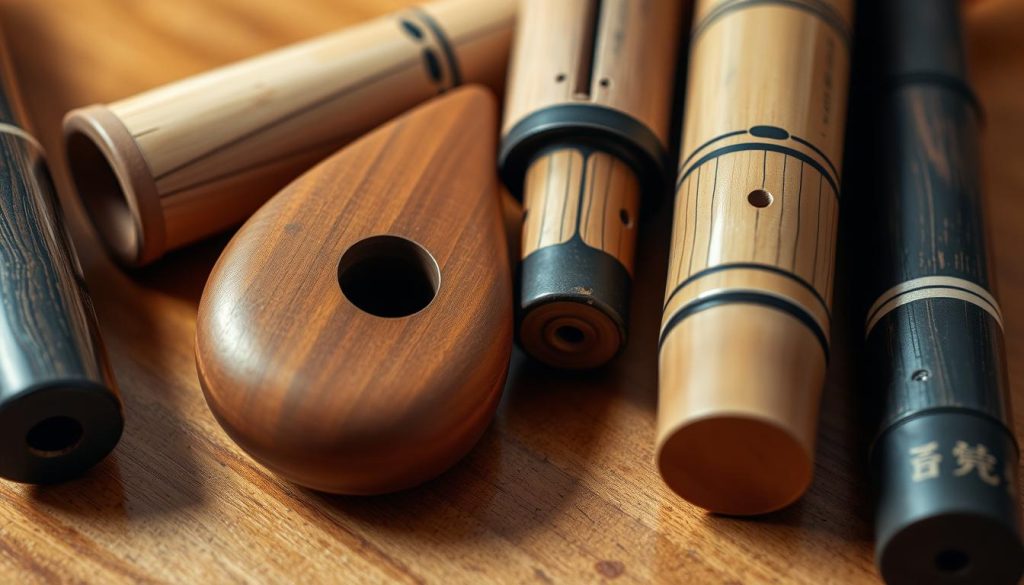
| Criterion | Single body | Set of pipes |
|---|---|---|
| Tuning | Mostly fixed | Adjustable pipe by pipe |
| Repairability | Low; breakage is often permanent | Some pipes can be replaced |
| Portability | Compact, fragile | Larger, more robust |
| Suggested use | Intimate playing | Projection in open spaces |
Tip: try several models and consult a detailed comparison to choose for your playing habits and budget.
Difficulty and learning curve
Learning often depends on access to resources and local support.
Availability: flute schools and repertoire have a long history. Online tutorials have grown substantially since the 1990s and now offer structured lessons for all levels.
Technique and teaching: perceived difficulty depends as much on having a teacher as on the method used. Buying a well-tuned ocarina from the start helps protect a beginner’s ear and maintain motivation.
Progress develops over several years. Regular weekly practice makes learning easier. Alternate breath and fingering exercises, then work on musical expression.
Joining a local or online community provides feedback and introduces new repertoire. With either instrument, combine technical care with work on musical phrasing.
| Resource | Benefit | Effect on progress |
|---|---|---|
| Video tutorials | Immediate access to varied lessons | Encourage independent learning |
| Teacher | Personalized corrections | Speeds up learning to play in tune |
| Community | Motivation and repertoire | Improves consistency |
| Quality instrument | Reliable tuning | Helps develop the ear |
Prices, availability, and beginner models
Price tiers reflect the material, tuning, and finish.
Entry level: plastic versions for beginners cost between €15 and €50. They are durable and convenient for travel.
Intermediate and handcrafted models: ceramic models offer greater tonal stability. They generally cost between €40 and €300. Double- and triple-chamber models often cost between €150 and €400.
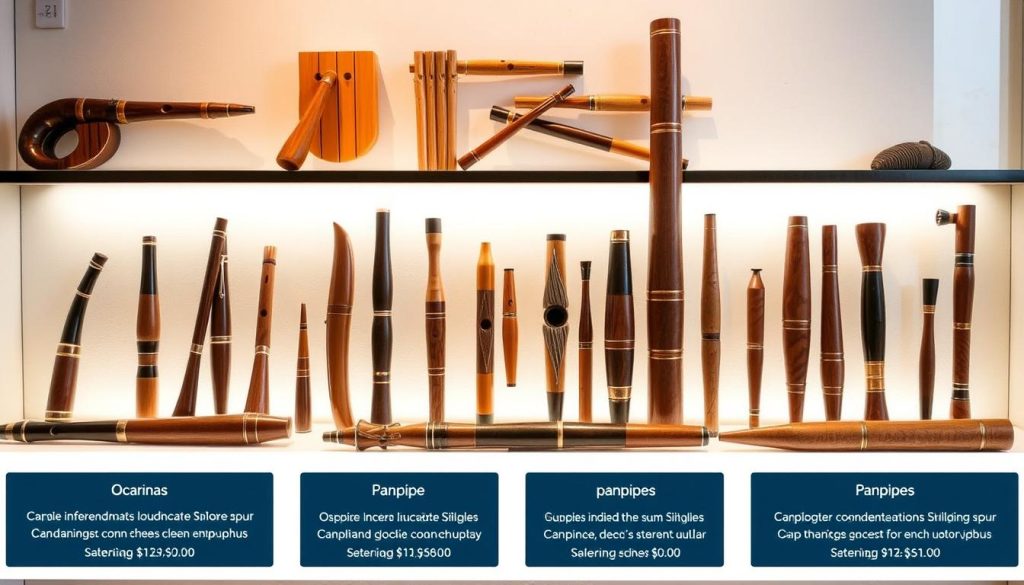
Pan flutes and the cost of construction
A pan flute’s price depends on the number of pipes, the bamboo or wood used, and the tuning. A good instrument can cost from a few dozen to several hundred euros, depending on its range and quality.
Practical advice:
- Start with reliable student models before investing in more advanced designs.
- Metal is uncommon; always check the finish, airtightness, and intonation when trying an instrument.
- Buy from respected makers or specialist shops that offer trials and returns.
| Category | Material | Price range |
|---|---|---|
| Beginner | Plastic | €15 to €50 |
| Intermediate | Ceramic | €40 to €300 |
| Professional or multi-chamber | Ceramic or wood | €150 to €400 |
| Pan flute | Bamboo or wood | A few dozen to several hundred euros |
When buying a good ocarina, favor sellers that offer trials and returns.
Musical styles and uses
These instruments suit a wide range of settings, from intimate solos to group projects.
Styles at a glance: the ocarina often appears in meditative solo music, film scores, and contemporary arrangements. The pan flute is prominent in Andean traditions, folk ensembles, and world-music or jazz fusions.
Ways to play: solo performance highlights nuance and delicacy. Ensembles bring different timbres into conversation, especially alongside percussion and strings. A musician rearranging a familiar theme can transpose a motif to give it a new character.
Educational use and creative connections
These musical instruments work well in workshops and classrooms. They introduce breath control, listening, and rhythmic coordination.
Bringing two worlds together: pairing a vessel flute such as the ocarina with a set of pipes enriches the dynamics and makes mixed repertoire possible. Explore collaborations and arrangements to make use of the complementary qualities of ocarinas and pan flutes.
Tip: try combinations in a small ensemble before taking them onstage.
How to choose according to your goals
Sometimes the best choice is the instrument that makes you want to play every day.
Start by defining your budget, the sound you want, and the time you plan to spend practicing. These simple considerations quickly narrow the choice.
Budget, preferred sound, and skill level
Budget: the ocarina is accessible if you want to start modestly; a simple model lets you learn without a major investment. A full pan flute often costs more, depending on its range.
Sound: if you want a rounded, intimate tone, the ocarina is a good fit. If you want a bright, projecting sound, the pan flute offers that effect and suits world music and fusion styles.
Skill level: progress with short pieces is often quicker. For longer programs, allow several years of study to master coordination and intonation.
Hands, ergonomics, and playing comfort
Consider your hand size and try the spacing of the holes or pipes. Comfort affects how long you can practice and the quality of the sound you produce.
Also assess weight and balance. A poor fit quickly tires the hands and reduces breath control on each note.
Practical advice:
- Listen to recordings and try the instruments in a shop.
- Ask a teacher or another musician for advice.
- If you are unsure, choose a well-tuned ocarina to help maintain your motivation.
| Criterion | Ocarina advantage | Pan flute advantage |
|---|---|---|
| Initial price | Accessible | Variable, often higher |
| Sound | Rounded and intimate | Projecting and bright |
| Learning curve | Quick for simple melodies | Longer for extended programs |
| Ergonomics | Compact, often comfortable to hold | Try before buying to check pipe spacing |
Between two excellent options, choose the one that best suits your daily playing and the sound you enjoy.
Conclusion
In this comparison, the main differences come down to shape, playing technique, and material.
These two instrument families differ in form—a rounded body versus a set of pipes—and in acoustic principle: a Helmholtz resonator versus air columns.
The number of holes, the presence of a fipple-style mouthpiece, and the material (ceramic, wood, plastic, or metal) influence tone color, durability, and price.
After centuries of invention and adaptation, every note deserves careful listening: breath, embouchure, and ergonomics remain decisive.
Try several models to compare ocarina hole spacing and how a pan flute feels in your hands. For a more complete guide, see this detailed comparison.
Ultimately: both the ocarina and pan flute can support lasting learning and musical enjoyment, from your first breath through years of exploration.