
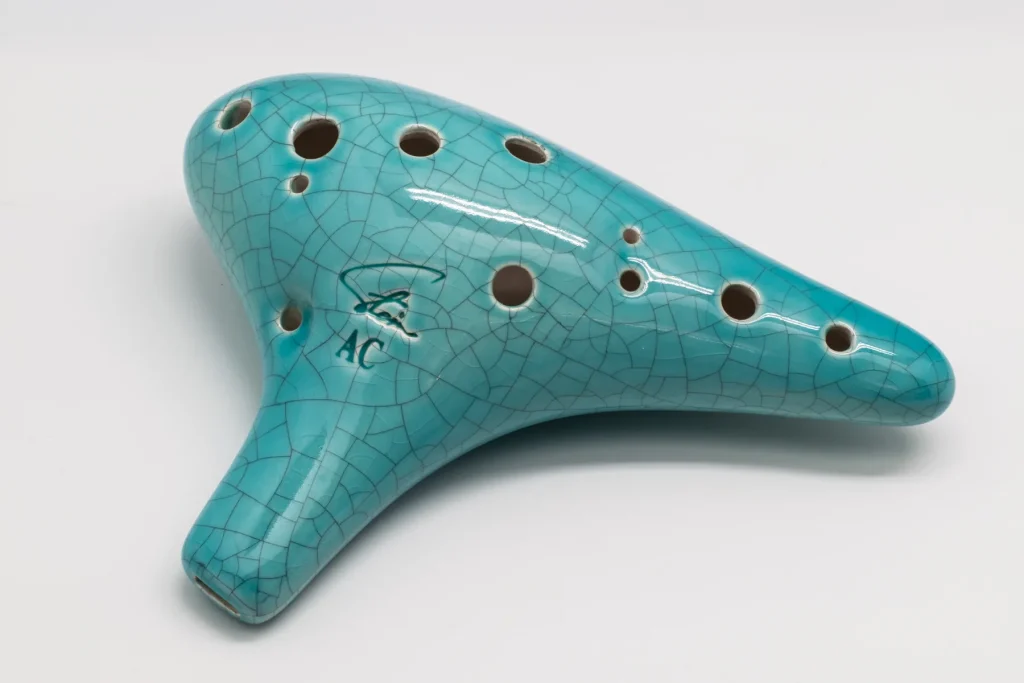
Introducing this instrument as an accessible choice for beginners is essential. This wind instrument is highly versatile for popular tunes and gentle music.
A well-tuned instrument requires careful craftsmanship. Choose specialist sellers such as STL Ocarina, Ocarina World (Stein/Focalink), Musique de Terre, Songbird, Spencer, or Dinda to avoid poorly tuned pieces sold on large online marketplaces.
The 12-hole format remains the modern standard. It covers up to 21 notes and suits beginners and advanced players who want a full range without excessive complexity.
The labels AC, Alto C, C3, and Tenor in C refer to the same type of instrument. Compare materials, ergonomics, and prices: ceramic produces a warm sound but is fragile; ABS plastic is durable and affordable; wood offers a different tone.
This guide aims to help you choose an alto C ocarina, with priority given to tuning quality, intonation, and stable high notes. The following sections cover the number of holes, range, tuning, materials, brands, budget, care, and accessories.
Why choose an alto C ocarina today?
The middle range appeals because of its balance: it combines full low notes with gentle high notes, making this wind instrument suitable for beginners and experienced players alike.
Versatility for different music: the key of C makes reading music easier and lets you play a variety of melodies with accessible intonation. It is an excellent choice for making quick progress.
Availability in France
In France, the local selection is strong: Ocarina World offers Stein/Focalink models from €42, and Musique de Terre sells handmade instruments crafted in France. Buying from the United States (STL, Spencer) remains possible, but involves a wait of around two and a half weeks, shipping costs, and possible taxes.
- Popularity: video game culture (Zelda) and relaxation practices drive demand.
- Practical advice: starting with an Alto C makes breath control easier to learn without demanding high notes.
- Budget: compare the final price with the quality guarantee and plan for possible stock shortages.
“A quality instrument speeds up progress: better intonation, more enjoyment, and less frustration.”
Alto C ocarina: models and buying advice
Before buying, identify the features that ensure accurate intonation and a comfortable grip.
Essential criteria before buying
Tuning and intonation: check the stability of the high notes, the response of the low notes, and consistency across the range. Poor tuning makes learning frustrating.
Ergonomics: check how the instrument feels in your hands and how far apart the holes are to avoid strain while playing.
Materials: ceramic offers a warm sound but is fragile. ABS plastic is durable and affordable, making it ideal for beginners.
Price and after-sales service: choose established sellers and reliable makers so you can get support if needed.
- Reputation: Stein/Focalink, STL, Musique de Terre, Dinda, Spencer, Hind, Pure Ocarinas.
- Number of holes: a 12-hole model covers up to 21 notes and supports learning.
- Practical checks: listen to demonstrations and read reviews of intonation and ergonomics.
Understanding the names
Alto C, AC, C3, and Tenor in C are names used for this register in C. The differences are mainly matters of terminology that vary by region or brand.
“A well-tuned instrument speeds up progress: better intonation, more enjoyment, and less frustration.”
Understanding the ocarina: a wind instrument with many forms
Played for millennia, this wind instrument has taken many forms around the world. It has existed for more than 12,000 years and appears in cultures far removed from one another.
In pre-Columbian America, clay instruments were often shaped like figures. The Maya, Aztecs, and Incas used them for music and rituals.
In China, the xun—a related ceramic instrument—appeared as early as the Xia dynasty. This family of instruments shows how ceramic and clay can produce varied, warm tones.
In Europe, Giuseppe Donati standardized the modern form in 1853. Its popularity grew during the 20th century, and double and triple versions later appeared in Asia.
The move to the 12-hole model made a full range suited to Western music possible. Shapes (transverse, pendant, and other crosswise designs) affect ergonomics and tone.
Easy to carry, this instrument makes learning more accessible. Understanding its history helps you choose the shape best suited to your needs and repertoire.
Number of holes and ease of playing
The number of holes directly affects how easy an ocarina is to learn and the sounds it can produce. Fewer holes simplify finger movements; more holes expand the playable range.
Four and six holes: beginners and children
Four- and six-hole formats are good for exploration and suit young musicians. They make breath control and fingering simpler.
A well-designed six-hole model can offer up to 17 notes, enough for many learning pieces.
Twelve holes: the standard for an extended range
The 12-hole model remains a reference point for beginners and professionals alike. It covers up to 21 notes and lets you play a broad repertoire without excessive complexity.
Ten or twelve holes: fingering and repertoire
The historic 10-hole model (Donati, 1853) has a distinctive sound. The later refinement to 12 holes added fingerings and notes that broaden its possibilities.
To progress, choose an instrument with accurate intonation and test how its high notes respond. Multi-chamber models can then extend the range for advanced playing.
Range and key: understanding the difference
Understanding range and key prevents confusion when choosing an instrument. Range describes how high or low it sounds—soprano (high), alto (middle), or bass (low)—and affects the mood of the music.
Key refers to the reference note (C, G, F, and so on). It determines the playable scale and the notes shared with other instruments. For example, an instrument in G sounds lower than one in C while sharing useful notes for playing together.
Which register suits which mood?
- Bass: deep atmospheres, larger instruments, and often higher prices.
- Soprano: a bright, more piercing sound suited to high melodies.
- Middle: a versatile register ideal for beginners and common repertoire.
“Choosing a middle-register instrument in C makes progress easier: a full range, straightforward reading, and a broad repertoire.”
| Feature | Key | Suggested use |
|---|---|---|
| Range | C / G / F | Match the mood (low, middle, high) |
| Shared notes | Vary with the key | Allow ensemble playing |
| Beginner | Alto C (AC/C3/Tenor in C) | Full range, easy-to-read music |
Materials and sound quality
The choice of material can profoundly change an instrument’s sound. It affects tone, projection, and care. Here is a guide to choosing for your needs.
Ceramic and terracotta
Ceramic offers a rounded, warm sound with good projection. Ceramic ocarinas are often favored for their rich overtones.
Terracotta is fragile, however. Use a hard case for transport and storage.
ABS plastic
Plastic is light and resists impacts and moisture. It offers excellent value for its price and durability.
ABS models such as “Night by Noble” or similar instruments are well suited to travel and learning.
Wood and porcelain
Wood (Hind Ocarina, for example) produces an organic, warm tone. It needs care appropriate to its sensitivity to humidity.
Porcelain has a refined appearance and a clear tone. It can be more slippery and requires extra care.
Tip: choose ceramic for its tone on stage, ABS for travel, or wood for a distinctive character. Reputable makers (STL, Ocarina World, Musique de Terre, Dinda, Spencer) offer more reliable quality regardless of material.

“The material determines how the highest and lowest notes respond and how steady the breath feels.”
Single, double, triple… and fingering systems
Moving from one chamber to several profoundly changes the range and playing technique. Multi-chamber instruments add octaves by letting you switch chambers through a second mouthpiece or dedicated holes.
Multi-chamber ocarinas: extending the range
Double, triple, and other multi-chamber models extend the range across several octaves. This opens harmonic possibilities rarely available on a single-chamber instrument.
Asian and Pacchioni fingerings
Asian fingering: a continuous progression from chamber I to chamber II maximizes the total number of notes available while playing.
Pacchioni fingering: overlapping transition notes make the tone more consistent across chambers and allow smoother changes.
When to move to a double or triple
Choose a double model with Asian fingering to cover around two octaves quickly. Pacchioni fingering will often require a triple model for the same range, but with greater tonal consistency.
Note: these models demand better coordination of hands and breath, are heavier, and cost more.
| Feature | Asian | Pacchioni |
|---|---|---|
Guide to multi-chamber instruments
Ergonomics, shapes, and grip
How an instrument feels in the hands often determines how quickly a musician progresses. Ergonomics affect posture, finger accuracy, and fatigue.
Transverse models and pendants feel very different. A transverse ocarina rests in the palms, supporting stability and projection. A pendant is often worn around the neck and suits short sessions and playing on the go.
The size and spacing of the holes should suit your hands. Holes that are too far apart cause strain; holes that are too small are harder to seal. Check that you can cover every hole without effort.
Weight and balance affect how the instrument sits in your hands. ABS plastic is lighter, which suits beginners and travel. Ceramic is heavier and feels stable, which some players prefer.
Practical advice: look for versions with finger supports or an angled mouthpiece if you feel strain. Consider models suited to small hands if necessary.
To refine your choice, try several shapes in a shop or consult a comparison of four-hole models, six-hole models, and 12-hole models before buying.
Choosing for your level and needs
Choosing an instrument suited to your level prevents frustration and speeds up progress.
Beginner: 12-hole Alto C, ceramic or plastic
For beginners, a 12-hole Alto C remains the best starting point.
Choose ABS if your budget is tight or you want a durable instrument.
Choose ceramic if you want a richer tone for your music.
Intermediate: accuracy and repertoire
At an intermediate level, focus on intonation and stability.
Try other keys (C, G, F) according to the music you play, such as Irish, medieval, or folk music.
Advanced: multiple chambers and expression
For the stage or performance, consider double or triple instruments.
Asian and Pacchioni fingerings offer different transitions and a wider expressive palette.
Relaxation, meditation, and folk: specific uses
For relaxation, favor a low range and a gentle tone.
For folk music, the alto or tenor combines projection and warmth, whether you accompany others or play solo.
- Progression plan: start with ABS → move to quality ceramic → choose a multi-chamber model as your skills develop.
- Recommended brands: STL, Stein/Focalink, Musique de Terre, Dinda, Spencer, Hind.
- Tip: practice breath control and dynamics at every stage.
“Listen to different models before committing: the fit between your style, the key, and the instrument makes all the difference.”
To compare six-, 10-, and 12-hole formats, consult this guide: which ocarina to choose.
Recommended brands and websites for France
To compare foreign offers with those from French shops, you need to know which sellers are reliable. Your choice affects the final price, delivery time, and after-sales service.
STL, Songbird, Spencer
STL Ocarina offers a wide collection of ceramic and plastic models. Account for shipping from the United States (around two and a half weeks, shipping and customs charges; free delivery on orders over $100).
Songbird focuses on understated designs and receives good reviews at moderate prices. Spencer targets the high end (around $199–$299) with luxurious finishes, but allow for taxes and delivery times.
Local artisans and distributors
Musique de Terre is a French artisan worth considering for sound quality and Pacchioni options. Ocarina World distributes Stein/Focalink models from €42, making them available in France.
Other brands to know
Dinda (handmade models at attractive prices of around €35), Hind (wood and a natural tone), and Pure Ocarinas (United Kingdom: precise ergonomics and intonation) complete the international selection.
Practical advice: compare prices, delivery times, customs charges, and after-sales service. Listen to demonstrations before buying and consult our ranking of the best models to narrow your choice.

Budget, price, and value for money
A few simple indicators can help you spot good value quickly.
Useful price points: beginner ABS plastic models cost around €15–€30. Stein/Focalink versions (through Ocarina World) start at about €42. Midrange ceramic generally costs €40–€80. Quality handmade models often exceed €100, while Spencer offers high-end finishes for $199–$299.
Assess value for money using three criteria: tuning stability, durability, and high-note response. Avoid cheap products sold on Amazon, Wish, or AliExpress: they are too often poorly tuned and hinder learning.
Practical tips
- Calculate the total cost: listed price + shipping + taxes.
- Choose specialist sellers (STL, Songbird, Ocarina World, Musique de Terre, Dinda).
- Start with a reasonable budget (ABS or Stein), then move up to ceramic or a handmade instrument.
- Watch for promotions and stock availability to manage your budget.
“A good instrument costs money, but saves time and brings more enjoyment.”
| Category | Indicative price | Main advantage |
|---|---|---|
| Plastic (ABS) | €15–€30 | Durable, ideal for beginners |
| Stein / Focalink | About €42 | Good balance of intonation and price |
| Ceramic | €40–€80 | Rich tone, greater musical expression |
| Handmade / high-end | > €100 ($199–$299 for some brands) | Stable tuning and distinctive character |
Final tip: building a small, balanced collection can cover different needs without exceeding your budget. Patience and informed choices improve your playing.
Intonation, tuning, and breath control
Testing intonation across the full range quickly reveals an instrument’s strengths and weaknesses. Start by comparing each note with a digital tuner, then listen for consistency between registers.
How to assess tuning: play slow scales and simple intervals. Check that the notes hold their pitch without “jumping” or “breaking” as you increase your breath pressure.
High-note stability: focus on the notes at the ends of the range. A good ocarina keeps a stable tone with normal breath pressure; high notes should not become piercing or out of tune.

Consistency between chambers and dynamics
On double or triple models, check that the chambers have similar tone and volume. Changes between chambers should sound musical.
Practice breath control with dynamic exercises: move from pianissimo to loud playing, then play slow descending scales. This helps keep the highest and lowest notes in tune.
- Compare your playing with reference recordings to train your ear.
- Avoid very cheap products on online marketplaces: their tuning is often poor.
- Remember that temperature and humidity affect the response; adjust your breath accordingly.
“A well-adjusted instrument tolerates changes in breath pressure better and makes musical playing easier.”
To explore this instrument’s history and discover famous pieces of music associated with it, consult this reference article.
The ocarina, video games, and popular culture
The wider public rediscovered this instrument through a beloved game series. The Legend of Zelda: Ocarina of Time made its game melodies familiar references.
Many players then learned to reproduce its iconic pieces. This interest expanded the collection of sheet music and tutorials available online.
That exposure also helped bring the instrument into film soundtracks and relaxation music. Its airy tone reinforces the dreamlike mood composers seek.
Zelda and its influence: motivation and repertoire
The video game introduced the instrument to a broad audience. Players share arrangements for Alto C, making it possible to vary the music without changing instruments.
Practical advice: start with simple game melodies, then expand your repertoire to traditional music. Listening to several versions helps you develop your own interpretation.
“Popular culture turned a small wind instrument into one recognized throughout the music world.”
| Influence | Effect | Practical result |
|---|---|---|
| Video games (Zelda) | Worldwide visibility | More beginners and sheet music |
| Soundtracks | Dreamlike atmosphere | Use in relaxation music and film |
| Online community | Shared arrangements | Easier access to repertoire |
Accessories, care, and durability
An ocarina’s lifespan depends on protection and regular care. A few simple habits preserve its intonation and tone.
Hard cases, straps, and stands: protection and transport
A hard case and a strap protect a ceramic or wooden instrument during transport. For outings, choose a padded bag that reduces impacts.
Between sessions, place the instrument on a stable stand to prevent it falling from your hand or a table.

Cleaning, storage, and precautions by material
After each use, clean around the holes and mouthpiece with a soft cloth. This prevents moisture buildup and preserves the instrument’s response.
Precautions: ceramic and clay are sensitive to impacts and sudden changes in temperature. Wood reacts to humidity: store it somewhere dry and monitor moisture levels.
Plastic withstands travel better, but keep it out of direct sunlight to preserve its condition and color.
- Keep spare parts and find repairers through specialist websites.
- Regular care preserves intonation and prevents costly repairs.
“Prevention—protection, cleaning, and proper storage—is the best investment in durability.”
Conclusion
, if you are unsure, choose a 12-hole model in C: it offers an excellent balance for beginners. This type of ocarina makes reading music easier and covers a broad repertoire.
Prioritize intonation, stable high notes, ergonomics, and material quality. Buy from specialists (STL, Ocarina World/Stein, Musique de Terre, Songbird, Dinda, Spencer, Hind, Pure Ocarinas) instead of general marketplaces.
If you are a beginner, start with an affordable ABS or ceramic model, then move to more demanding or multi-chamber versions. Work on your breath, listen carefully to every note, and consider your budget, delivery times, and after-sales service.
Ultimately, this instrument remains a living link between tradition and modern music. Follow this advice to make a lasting, musical choice.