
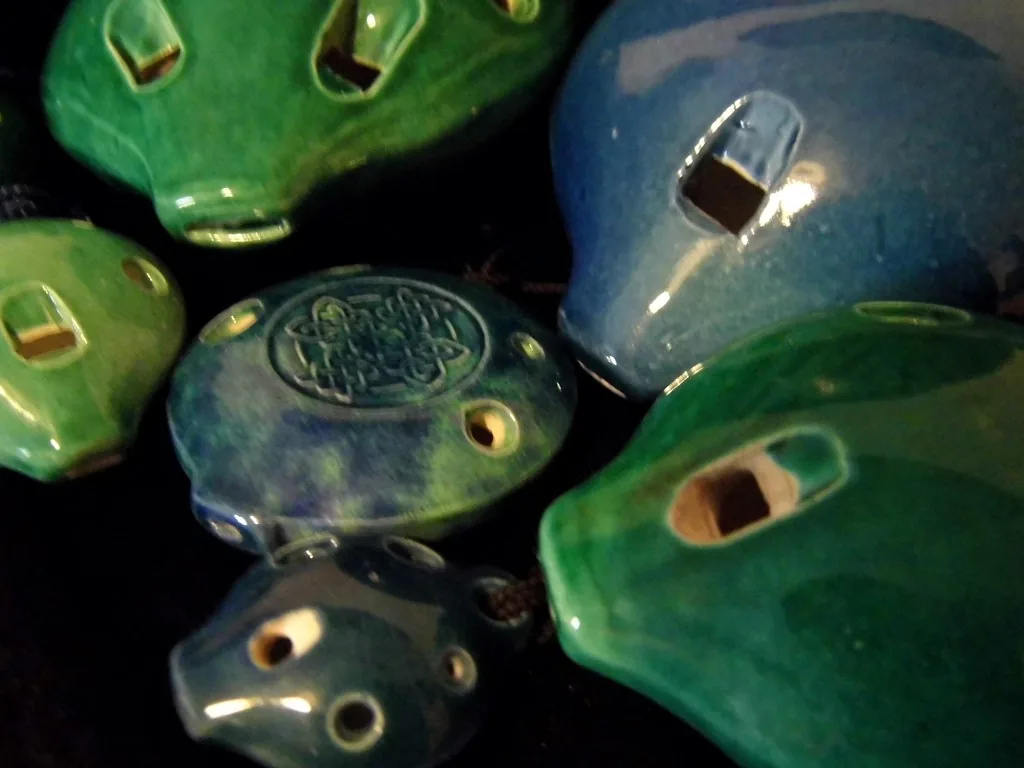
This article sets out the basics: your choice between two models affects how your playing develops, how easily you can perform, and the quality of your musical transitions.
Far from being a mere toy, this instrument calls for quality to take priority over appearance. Multichamber models, like transverse, inline, and pendant versions, serve very different purposes.
We will compare the essentials in practical terms: ergonomics, learning curve, tonal consistency between chambers, and breath control. Well-known makers (STL Ocarina, Noble, Focalink/Stein, Musique de Terre, Dinda) will illustrate real examples.
Finally, we will warn you about poorly tuned, low-quality models sold on general marketplaces. The aim is simple: to help you make the right choice today while anticipating how you may develop as a musician over the next few years.
Why consider a multichamber ocarina today?
For a musician seeking a wider range, moving to a multichamber model changes what is possible.
Meeting the need for a wider range
A 12-hole transverse ocarina covers about 21 notes, or nearly an octave and a half. That is enough for many pieces; more demanding music may call for lower or higher notes.
When a 12-hole transverse ocarina is no longer enough
Additional chambers add playable sections, each with its own mouthpiece. They give you access to more registers without switching instruments mid-piece, improving continuity.
Bear in mind that more holes and multiple mouthpieces lengthen the learning curve. Reputable makers (Focalink/Stein, STL Ocarina, Musique de Terre) offer reliable models; avoid poorly tuned, low-quality ones.
In practice, this instrument becomes more versatile for performance and recording, but it takes time and patience to master. Make your choice according to your repertoire and pace of progress.
A quick guide to ocarina types and their uses
Here is a brief overview of common shapes and their musical uses. It will help you choose according to your repertoire and portability needs.

Transverse, inline, pendant, and globular flutes
The 12-hole transverse ocarina, popularized by Donati and Aketagawa, remains the modern standard. Its practical range makes it a good compromise for beginners and professionals alike.
Inline models have a mouthpiece aligned with the body. Players appreciate their ergonomics, but they are less common because larger versions have lower acoustic efficiency.
Pendants are very easy to carry and often have 4 to 6 holes. They are ideal as decorative objects or for an introduction to the instrument, but their accuracy is limited.
Globular flutes, rooted in South American traditions, include both tourist versions and serious models sold in specialist shops.
How the number of holes affects playable notes
The number of holes (4, 6, or 12) directly affects the available range. Four or six holes are enough for casual playing; twelve allow you to play a much broader repertoire.
- Tip: for effective learning, choose a 12-hole model in C.
- Remember: shape affects balance, but your musical purpose should come first.
Double or triple ocarina: advantages and limitations
Moving to an instrument with several chambers changes the balance between range and ease of handling. A two-chamber model adds a second cavity to extend beyond the range of a 12-hole transverse ocarina while remaining ergonomic.
Advantages of a double: a straightforward extension and manageable ergonomics
The second chamber adds relatively little complexity. The instrument still feels natural to hold, breath control remains manageable, and the total number of holes increases without radically changing finger positions.
Advantages of a triple: a wider palette and smooth transitions
A three-chamber model extends the range and makes register changes easier. Transitions are smoother with good Pacchioni fingering; handmade models such as the Musique de Terre Triple C3 can also have very consistent tone.
Shared limitations and when a triple becomes counterproductive
The drawbacks are greater weight, the coordination needed to move between chambers, and a longer learning curve. If your repertoire needs little extra range, a triple may be unnecessary.
- Test the ergonomics: finger reach and access to the mouthpieces.
- Check tuning and consistency between chambers before buying.
- Consider how many notes you can actually use, rather than the number of holes alone.
Multichamber fingerings: Asian and Pacchioni
Your choice of fingering system profoundly changes how you play an instrument with several cavities. Understanding both approaches will help you adapt your practice to your repertoire and skill level.
Continuity between chambers with Asian fingering
Asian fingering treats the second chamber as a direct continuation of the first. This approach maximizes the number of accessible notes with relatively few chambers.
On a well-designed double, you can reach nearly two octaves by linking registers without making the instrument harder to hold. It is an effective option for a musician seeking a wide range.
Overlap and tonal consistency with Pacchioni fingering
The Pacchioni approach favors overlap: the last notes of one cavity are also the first notes of the next. The result is more consistent sound quality and less noticeable transitions.
Covering two octaves with this method often calls for a triple. Recordings and concerts particularly benefit from that continuity.
Which fingering system suits your repertoire?
If your repertoire mainly demands range, the Asian approach makes efficient use of the number of holes in each cavity.
If you value fluidity and consistency between registers, Pacchioni may suit you. Consider your experience: Pacchioni requires a more detailed mental map of the notes.
Listen to demonstrations of different models before buying. There is no absolute rule: choose what best serves your musical experience.
Pitch ranges and repertoire: choosing a chamber and a tuning
Choosing the right chamber means finding the tone color and range that suit your repertoire. Pitch range affects timbre, the length of musical phrases, and breath control.

Soprano, alto/tenor, and bass: tonal character
Sopranos are small, bright, and sometimes piercing. They work well for lively passages and high melodies.
Alto/tenor models offer an ideal balance for most pieces. A 12-hole model in C (Alto C/AC) remains the recommended choice for beginners.
Bass models have a deep, warm tone. They require more breath, are larger, and demand more control over playing posture.
Examples of pieces and their range requirements
Video game medleys and film music sometimes require a range that extends upward or downward to reach particular notes. Intermediate and advanced musicians will benefit most from a multichamber extension.
- Master a 12-hole model before adding another chamber.
- Choose the chamber according to the tone color you want for a given note, especially with Pacchioni fingering.
- Listen to comparison recordings to confirm your preference.
Materials and sound quality in multichamber models
Material affects both tone color and projection.

Ceramic/clay: fired clay offers remarkable warmth and harmonic variety. Its projection helps the instrument carry on stage. Makers such as Musique de Terre (Gosselink) and Dinda produce well-finished ceramic instruments.
Ceramic and projection
The internal shape of the chambers and the consistency of their cavities determine the stability of intonation and note attacks. Good design improves sound quality.
Plastic and wood: uses and timbres
Plastic, exemplified by Night by Noble, is durable and stable for travel and rehearsals. It can offer slightly less tonal nuance.
Wood is rarer (Hind) and has a distinctive timbre. It appeals to curious ears but needs maintenance and careful handling.
“A good model made by a skilled craftsperson will make the difference clear from the first note.”
| Material | Strength | Recommended use | Example |
|---|---|---|---|
| Ceramic/clay | Warmth, projection | Performance, recording | Musique de Terre, Dinda |
| Plastic | Durability, stability | Travel, rehearsals | Night by Noble |
| Wood | Distinctive timbre | Collecting, acoustic projects | Hind |
Tip: choose a material for your intended use—performance, travel, or recording—and compare ceramic and plastic models to hear the difference. Avoid poorly tuned entry-level models sold on general marketplaces. To help with your initial choice, read our guide to choosing a 6-, 10- or 12-hole model.
Ergonomics, breath, and playing level
How you hold the instrument affects both its sound and your stamina. Its weight, size, and mouthpiece layout affect posture and fatigue during long sessions or standing performances.

Managing weight and multiple mouthpieces
A heavier instrument puts more strain on your shoulders and fingers. This can create tension that reduces accuracy.
Choose a comfortable model that does not force you into awkward positions. Try holding it before you buy.
Breath control between chambers
Moving from one cavity to another requires you to balance air pressure and airflow. You can develop this control through targeted exercises in connecting notes and breathing.
Steady breath remains a challenge, especially on versions with several mouthpieces. Practice short note attacks and sustained notes to improve consistency.
Beginners, intermediate players, and experts: a realistic path
For most players, a 12-hole Alto C transverse ocarina remains the best starting point. It lets you learn the fundamentals without excessive complexity.
Then, depending on your repertoire and level, increase the complexity: move to a double if needed, and then to a triple if your needs justify it.
- Take breaks, and warm up your hands and breath before playing.
- Few players make full use of a triple before mastering intonation.
- Patience and regular practice matter more than owning a complex model.
| Factor | Effect | Practical advice |
|---|---|---|
| Weight | Muscle fatigue, posture | Test it while standing; prioritize comfort |
| Multiple mouthpieces | More complex breath control | Practice transitions and controlled breathing |
| Note accuracy | Quality of attacks and sustained notes | Practice short attacks and legato deliberately |
To explore your choice further and understand its technical implications, read our practical guide to multichamber models: multichamber guide.
Budget, price, and practical value
The listed price does not always reflect the total cost: additional charges and technical choices also matter.
Price ranges from doubles to triples
As a guide to the market, a Stein/Focalink Alto C starts at around €42 from Ocarina World (France). STL Ocarina offers models priced from €50 to €200, depending on the finish.
Handmade three-chamber models, such as the Musique de Terre Triple C3, tend to cost several hundred euros.
Hidden costs: delivery, customs, and accessories
Shipping from the United States often brings delivery charges and delays (around 2.5 weeks). For purchases over €150, budget roughly another 20% for taxes and customs charges.
Few very cheap models offer reliable tuning. An apparent saving may turn into adjustment or replacement costs.
- Budget for a case, cloth, stand, and cord to protect the instrument.
- Allow for delivery time if the purchase is for a gift or concert.
- If possible, buy in France or the EU to make returns and after-sales support easier.
| Category | Indicative price | Strength | Advice |
|---|---|---|---|
| Entry level | €42–€80 | Low price, easy access | Check tuning and hole consistency |
| Midrange | €80–€200 | Better quality, choice of finishes | Compare STL Ocarina with European brands |
| Premium handmade | €200 and up | Consistent sound, careful finish | Consider for a special occasion or professional use |
| Additional costs | €10–€60 | Accessories, shipping, customs | Include them in your final budget |
Recommended makers and models
Craft makers and commercial brands take very different approaches to design and tuning. Choosing a maker suited to your level helps avoid unpleasant surprises.
Key points
STL Ocarina has a large catalog for all levels, including themed sets and multichamber models. Allow for shipping costs and delivery times from the United States.
Night by Noble (plastic) is durable and stable, useful for travel or as a companion to a ceramic transverse ocarina.
Musique de Terre (Gosselink) makes Pacchioni triples known for consistent timbre and stability, ideal for performance and recording.
Dinda offers accessible Alto C models appreciated for their high notes and comfortable breath response. Focalink/Stein remains an affordable choice for a first transverse instrument in France.
| Maker | Strength | Recommended use |
|---|---|---|
| STL Ocarina | Variety of models | All levels, multichamber playing |
| Night by Noble | Durable plastic | Travel, rehearsals |
| Musique de Terre | Consistent timbre | Concerts, recording |
| Dinda / Focalink | Accessible price / good value | Beginner to intermediate |
Tip: assess sound quality, the number of holes, and the ergonomics of each chamber. Listen to demonstrations and, if possible, try the instrument in a shop.
Where to buy in France and avoid mistakes
For help choosing your instrument, visit specialist shops that can advise you. In France, favor retailers that test and adjust instruments before shipping them.
Specialist shops in France and online
Ocarina World distributes Focalink/Stein (Alto C from around €42) and offers straightforward delivery. Instruments du Monde offers a wider selection, including multichamber models.
Contact these shops for advice about your hand size and how well an instrument will fit you. Trying the model or asking for a video can help you choose.
Avoiding poorly tuned, low-quality models
Many general marketplaces offer attractive-looking items with questionable tuning. Avoid Amazon and Wish for this wind instrument if you want good quality.
Before buying secondhand, check the tuning, look for cracks, and research the seller’s reputation. A poorly tuned instrument quickly becomes discouraging and wastes learning time.
- Favor French shops to make returns and after-sales support easier.
- Combine your orders from STL Ocarina to reduce shipping costs from the United States, while allowing for taxes.
- For beginners, a 12-hole transverse ocarina is often the best first purchase.
| Option | Strength | Practical advice |
|---|---|---|
| Specialist shops (France) | Advice, easier returns | Ask for a trial or video; check availability |
| International retailers (STL Ocarina) | Wide selection, rare models | Combine orders; budget for taxes |
| General marketplaces | Sometimes low prices | Avoid if quality is uncertain; check reviews |
Conclusion
In short, the essential thing is to choose an instrument that suits your musical goals.
For most uses, a well-made 12-hole transverse ocarina remains a reliable foundation for progress. A second chamber extends the range without making the instrument excessively difficult to hold; a third chamber mainly serves repertoire that demands smooth transitions and consistent timbre.
Prioritize tuning, ergonomics, and tone. Try instruments, listen to demonstrations, and compare shapes, breath response, and playing comfort. Avoid entry-level models from general marketplaces that can hinder progress.
Your plan: strengthen your technique, identify the range your pieces need, then refine your choice of chamber and fingering system. For a simple explanation of types and uses, read this practical guide: what an ocarina is—a definition.