
Playing your first chords can feel intimidating. Yet a simple progression soon turns uncertainty into real enjoyment. Learning guitar mainly depends on a clear method, regular practice, and achievable goals.
This guide covers each step: choosing your first guitar, tuning, posture, essential chords, rhythm, and initial techniques. The Cort AD810, Yamaha FX310, and Ibanez AE245 NT offer useful starting points for beginners.
You do not need the talent of Jimi Hendrix, Kurt Cobain, or Eric Clapton. A 30-minute session helps you improve, while 10 to 15 minutes can maintain your skills on busy days.
Choosing the right gear makes every exercise easier. A comfortable instrument, a few useful accessories, and a reliable tuner help you stay motivated. With patience, careful listening, and consistency, anyone can learn guitar at their own pace, without pressure.
Enjoyment remains the best reason to keep making music. The advice here offers a realistic path suited to each learner’s time and interests.
How can you learn acoustic guitar as a beginner?
A clear path makes each step easier. To learn guitar, combine the right gear, good posture, chords, rhythm, and a repertoire of songs. This approach also helps you understand your instrument and develop a pleasing sound.
Regular practice matters more than an occasional long session. Aim for around 30 minutes a day. After a break, start again without guilt: a few exercises are enough to regain your bearings and keep playing guitar.
Several options can suit your budget. An online course often costs €15 to €30 a month. A teacher generally charges at least €25 to €30 per lesson. Video tutorials, apps, and independent practice complement these options.
Next, set a specific goal: accompany songs, play with friends, or understand music and rhythm better. A guitarist progresses faster with a motivating goal. Explore these steps for learning guitar too.
Every small success encourages you to continue.
Choose a suitable first acoustic guitar
The right choice depends mainly on comfort, the style you want to play, and your budget. An enjoyable instrument makes you want to practice more often. Read this guide to choosing your first guitar before buying one.

Classical or steel-string: which should you choose?
A classical guitar has a wider neck and nylon strings. Their lower tension is gentler on your fingers during your first sessions. A steel-string acoustic guitar uses steel strings. It suits pop, folk, popular songs, and many styles of accompaniment. It is therefore highly versatile, while nylon feels softer to the touch.
Assess the size, quality, and price
Try the body and neck, and check how easily you can reach the frets. A smaller person may prefer a smaller guitar. Check the string action, finish, and tuning stability too. The Cort AD810, Yamaha FX310, and Ibanez AE245 NT are three models worth comparing.
- Avoid an instrument costing less than €150: quality and comfort are often limited.
- Budget €150 to €350 instead for a reliable model.
- An electric version usually requires an amplifier and is less convenient to carry.
Let comfort guide your choice before appearance or price.
Gather the essential accessories
A few well-chosen accessories make each session smoother. They protect your instrument, make tuning easier, and improve comfort. Set aside a place to store them after each use.
Tuner, pick, case, strap, and capo
A tuner helps you play in tune at every session. A spare set of strings prevents a broken string from interrupting your practice. A capo attaches quickly to the neck when you want to change key.
Here are a few priority accessories for getting started:
- A flexible pick, between 0.60 and 0.80 mm thick.
- A case to protect against dust and knocks.
- A strap at least 5 cm wide for greater neck and shoulder comfort.
- A capo suited to common guitar models.
A case also makes guitars easier to transport. A strap helps you play standing up without tensing your upper body. For a reliable guitar and its accessories, the average overall budget is €300 to €500. Read this guide to guitar accessories before making your choice.
Understand guitar anatomy
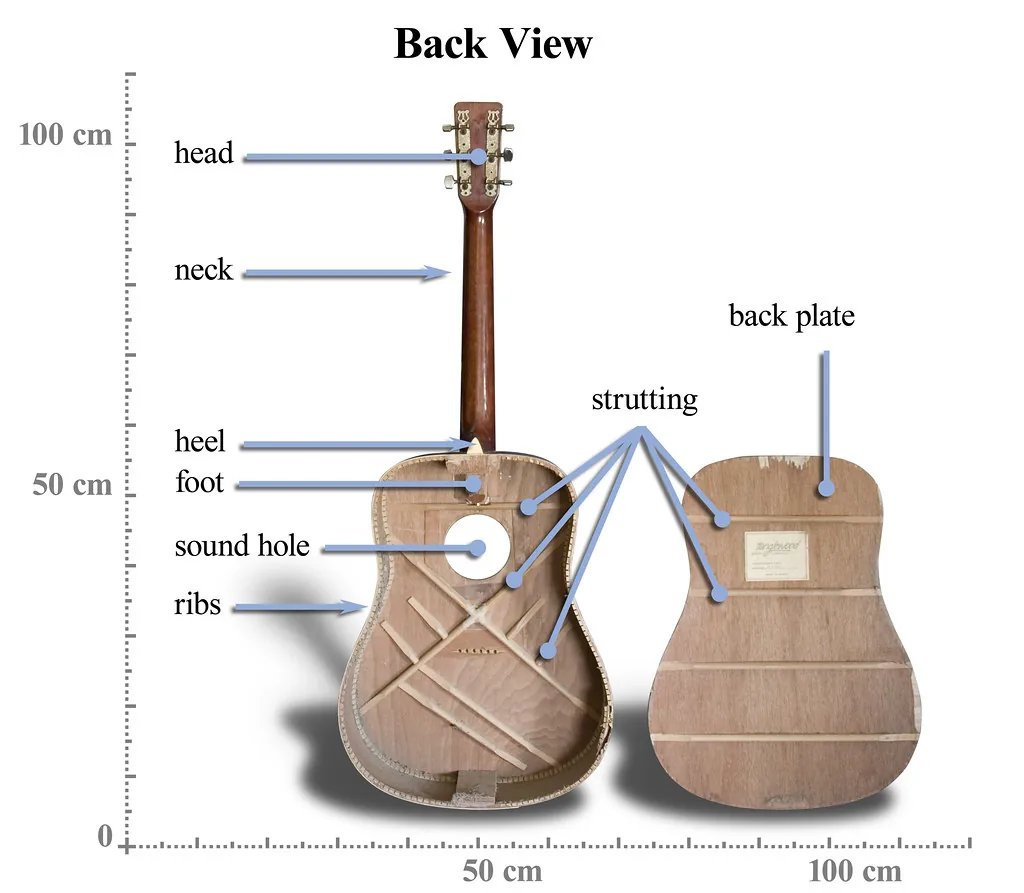
Each part plays a specific role in comfort, sound, and tuning. Looking closely at the instrument helps you position your fingers and understand useful playing movements.

The neck, fretboard, and frets
The guitar neck supports the fingers that form notes and chords. Its fretboard has metal frets. Each fret raises a note by a semitone. This layout helps you find your way around, even during your first exercises.
The strings, body, and soundboard
The six strings follow standard tuning: E, A, D, G, B, E, from low to high. Made of steel or nylon, they vary in tension and diameter. A common steel-string gauge is 12/53. Higher tension often produces more volume but tires the fingers more.
The resonant body and soundboard amplify vibrations. Each type of wood also influences the tone.
The bridge, nut, and tuning machines
The bridge and nut affect string action and intonation. The tuning machines then help keep the guitar in tune. A good setup makes each note clearer.
Choose an effective learning method
A suitable path turns each session into visible progress. To succeed in learning guitar, choose a method that fits your goals, budget, and available time.

Compare a teacher, online lessons, and self-study
A teacher watches you play, corrects your movements, and offers personalized guidance. Human contact can be motivating, though lesson times are less flexible. Expect to pay around €25 to €30 for a private lesson.
Online courses often cost €15 to €30 a month. Each lesson is available at your chosen pace on a computer, tablet, or smartphone. Self-study draws on books, websites, and videos, and requires strong discipline.
- Teacher: close guidance and direct expertise.
- Online courses: flexibility and a lower average cost.
- Self-study: freedom, but less guidance.
Define your goals and musical style
A guitarist might want to play simple songs, join a band, improvise, compose, or play electric guitar. These goals shape the choice of instrument, chords, and rhythms.
France’s Pass Culture can provide up to €300 at age 18. Regional, departmental, municipal, and intermunicipal conservatories also offer instruction. To learn electric guitar, choose a method suited to the styles you want to play.
Adopt a good playing posture
A stable position makes every session more enjoyable. Before playing, straighten your back, relax your shoulders, and keep your elbows loose. Steady breathing also helps reduce tension.

A right-handed player can rest the body on their right thigh. A footrest can then raise the instrument and make the strings easier to reach. A left-handed player naturally reverses this position. Your posture should remain comfortable, without straining your hips or neck.
- Place your thumb behind the neck to balance your hand and keep your wrist flexible.
- Keep your fingers close to the frets to produce a clear sound with little pressure.
- Check your posture after a few minutes of playing, especially if you feel discomfort.
To play standing up, attach a wide strap and adjust it to the right height. Keep the body close to your torso without pulling on your shoulder. Good posture protects your body and makes each movement more precise. Read this guide to holding your guitar correctly and play with greater ease.
A few adjustments can preserve your comfort and enjoyment over time.
Tune your acoustic guitar correctly
Accurate tuning immediately changes the sound of your instrument. Spend a few minutes before each session getting clear, pleasing notes.
Learn the notes of standard tuning
An electronic tuner, tuning fork, or app provides a reliable reference. Memorize this sequence from the lowest string to the highest: E, A, D, G, B, E.
- Tune the low E first, then the A.
- Compare the open D with the A string pressed at the fifth fret.
- Check the G, then compare the B with the G string pressed at the fourth fret.
- Check the high E against the B string pressed at the fifth fret.
- For the low E, listen to the D string pressed at the second fret.
Without a device, this method requires careful listening. String type and tension can slightly affect the result. Play several chords afterward, then fine-tune each string if the guitar sounds out of tune.
Accurate tuning makes every step easier and more rewarding.
See this guide to tuning your guitar, then read this method for reading tablature.
Read tablature or sheet music
Learning to read a song quickly gives you more independence. Tablature or sheet music shows you where to place your fingers and how to follow the rhythm. Reading it also supports playing with a pick.
Understand strings, frets, and symbols
Tablature has six lines. The top line represents the high E string and the bottom line the low E. The letters E, A, D, G, B, and E indicate standard tuning.
- Each number identifies a fret on the neck.
- The symbol 0 means an open string.
- Read tablature from left to right.
This lets you identify the string and fret to play before forming chords.
Understand notes, rhythm, and markings
Sheet music includes a staff, clef, notes, note values, tempo, dynamics, and repeat signs. Note values show how long sounds last. Rhythm guides your hand and helps you play more consistently.
A teacher can explain symbols or particular techniques. Short lessons can also help you improve efficiently.
Start with a simple bar, then gradually increase your speed.
| Format | Main reference | Use |
|---|---|---|
| Tablature | Lines and numbers | Quick finger placement |
| Sheet music | Notes and values | Complete musical notation |
| Both | Rhythm and movements | More precise learning |
Learn notes and basic chords
Finding notes gives you a solid foundation for progress. On the guitar neck, each fret raises a note by a semitone. The sixth string is the low E, while the first produces the high E. A tablature line then shows which string and fret to use.
Form and change between essential open chords
The C, G, D, E, and A chords provide a useful foundation for many songs. For C major, place one finger on the first fret of the B string and another on the third fret of the A string. For D major, use the second fret of the G string and the third fret of the B string, among other positions.
- Form each chord slowly.
- Listen to every note to find any muted strings.
- Use a tuner before each exercise.
- Practice two chords, then gradually add the others.
Keep your hand relaxed and place your fingers close to the frets. This makes your playing clearer. With a few minutes of regular practice, learning guitar becomes easier and your playing more fluid.
Accuracy comes before speed.
Practice rhythm and arpeggios
Rhythm brings chords to life and guides every movement. A bar in 4/4 has four beats, each equal to a quarter note. Start slowly so you can feel each beat before adding variations.
Master downstrokes and upstrokes
Mute the strings with your left hand, then repeat downward and upward movements with the other hand. This isolates the movement without the distraction of chords. A flexible pick between 0.60 and 0.80 mm gives you a clear, comfortable attack.
Coordinate both hands with a metronome
Set the metronome to 60 beats per minute. Play four downstrokes per bar, then add upstrokes. Stay relaxed and raise the tempo only after several even repetitions.
Move from strumming to arpeggios
Strumming makes several strings ring together. In an arpeggio, your fingers or pick play each string separately. This creates a softer sound suited to various styles and songs. Try a ballad, shuffle, reggae, and a campfire strumming pattern.
“Accuracy grows from calm, steady movement.”
To explore these movements further, read this guide to arpeggios.
Organize your practice and expand your repertoire
A simple plan makes each session something to look forward to. To support learning guitar, choose a realistic time and keep your instrument in sight. This habit makes it easier to start playing.
Create a regular routine that fits your schedule
A 30-minute session can include warming up, tuning, chords, rhythm, arpeggios, and work on a song. On busy days, 10 to 15 minutes is enough to stay familiar with your acoustic guitar without adding pressure.
- Set measurable goals: make a chord change smoothly or finish a song each week.
- Record each improvement in a notebook to see your progress.
- Use lessons, tablature, and GalagoMusic’s free tutorials.
Choose accessible songs to stay motivated
Start with short songs that use few chords and a steady rhythm. Then add more complex styles and movements. Listening to different genres develops your tastes and helps you build a personal repertoire.
Consistency matters more than the perfect session length.
| Length | Suggested activities | Goal |
|---|---|---|
| 10 to 15 minutes | Tuning and rhythm | Stay familiar with the instrument |
| 30 minutes | Technique and a song | Improve every day |
| 45 minutes | Repertoire and styles | Develop well-rounded playing |
Develop your technique to keep improving
Every new movement opens up more musical freedom. This stage comes after open chords and uses short, regular exercises. As you learn guitar, progress without chasing speed.
Discover barre chords, picking, and key playing techniques
Try barre chords once your fingers can press several strings without pain. Picking develops independence in your right hand and makes each attack more precise. Hold the pick between your thumb and index finger, with 2 to 3 millimeters extending beyond them.
- Practice hammer-ons and pull-offs to connect two notes without another pick stroke.
- Add bends to change a note through controlled string tension.
- Try slapping for a percussive attack.
A relaxed left hand makes every movement easier. Repeat each technique slowly, then combine them in a short pattern. This approach enriches your playing, encourages improvisation, and helps you compose. The playing of Satriani and Django Reinhardt offers two very different sources of inspiration.
“Mastery grows from curiosity practiced every day.”
Notice your progress: a few minutes of focused practice are more useful than forced effort.
Conclusion
Your progress takes shape through simple, repeated movements. To learn guitar effectively, choose a comfortable instrument, check its tuning, and keep your posture relaxed. A well-set-up acoustic guitar makes every session more enjoyable.
Open chords, tablature, rhythm, and arpeggios form a logical path. Ten to fifteen minutes of practice maintains your skills. A daily 30-minute session lets you work on technique, a song, and listening, helping you play with greater ease.
Depending on your goal, combine online lessons, free resources, and guidance from a teacher. An extra lesson can strengthen a particular skill. A flexible method supports every guitarist while leaving room for independent practice.
Choose accessible songs so you can hear a musical result quickly. Patience, consistency, and enjoyment make music accessible at any age. Keep your instrument close, progress without pressure, and celebrate every chord you play well.