
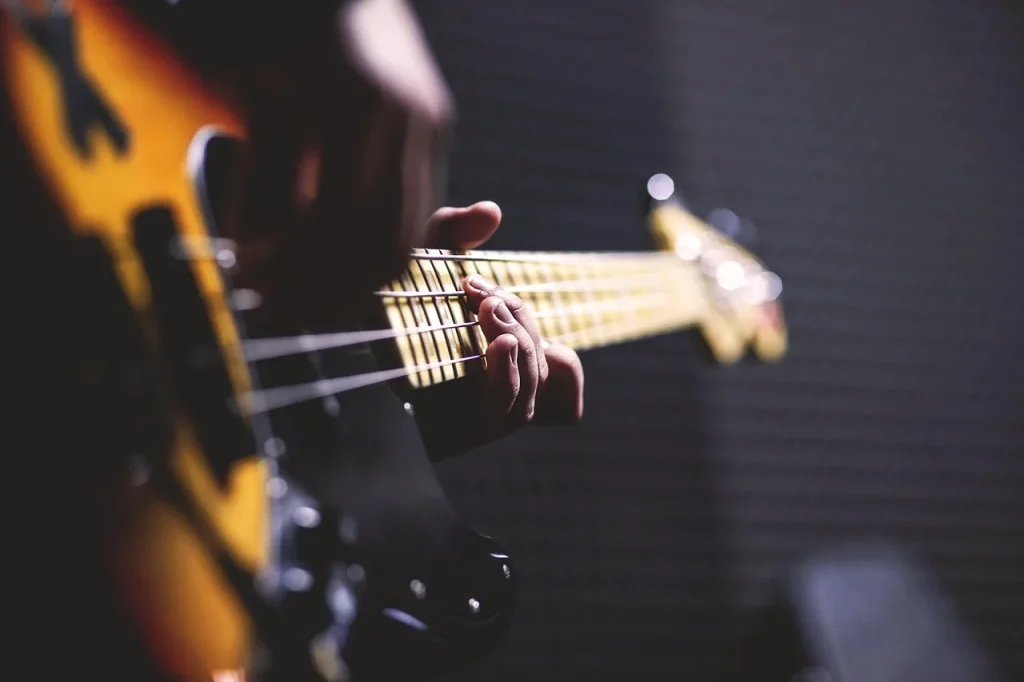
Welcome to our guide to bass guitar exercises for beginners! If you want to learn bass guitar as a beginner, these simple, effective exercises will help you get started.
We will explain why it is important to warm up your hands and fingers before playing, then introduce techniques suitable for beginners. A variety of exercises will improve your agility and flexibility, two valuable skills as you progress through your beginner bass guitar lessons.
We also suggest useful resources, including warm-up videos and practical guides. For more essential exercises, visit this dedicated page.
Introduction to bass guitar exercises
Bass guitar exercises for beginners are essential when learning to play this instrument. They develop the skills needed for confident, expressive playing.
With regular practice, beginners improve their technique and posture. They become familiar with the bass guitar and prepare to play more creatively and expressively.
The online bass guitar course from imusic-school follows a structured progression. It covers notes, scales and rhythms while encouraging students’ creativity.
Beginners develop their dexterity and become familiar with the fretboard. They learn the notes on the E and A strings, giving them a solid foundation for the rest of their musical journey.
Together, these exercises prepare bassists to improve and to play better with other musicians, particularly in a band.
| Aspect | Description |
|---|---|
| Basic techniques | Learning the first notes and positions on the bass fretboard |
| Rhythms | Exercises using different rhythmic patterns, such as eighth notes and sixteenth notes |
| Scales | Practising major and minor scales to improve improvisation |
| Progression | Gradually increasing the difficulty of exercises to stay motivated |
Bass guitar fundamentals
Playing bass guitar requires mastery of certain techniques. Beginners need to understand the importance of right-hand technique for producing a clean, dynamic sound.
It helps to start with basic bass guitar exercises. They strengthen the fingers and make playing more fluid.
Why right-hand technique matters
The right hand is essential to producing sound. Beginners should practise raking and alternating between the index and middle fingers. These techniques help them create repeating rhythmic patterns.
Playing with two fingers is a good approach for beginners: it makes coordination and control easier.
Left-hand techniques to master
For the left hand, learn to position your fingers correctly and move them efficiently along the fretboard. Good finger placement produces clear notes without buzzing.
Understanding chord structures and scales is also important for enriching your playing over time. Many online tutorials can help you improve.
Regular practice is recommended. Practising for about 30 minutes a day builds dexterity and musicality. Basic bass guitar exercises should be done with a metronome to improve rhythmic accuracy and dynamics.
Bass guitar exercises for beginners
Beginner bassists need suitable exercises to make steady progress. These exercises develop essential skills and build confidence.
Practising at different speeds is important. A metronome helps you keep time. Position your left hand carefully to avoid scraping sounds.
Keep steady pressure on the strings, as it affects sound quality. Good string control also makes bass guitar tablature easier to read.
Major and minor scales
Scales are essential for bassists. Learning to play major and minor scales helps you recognize patterns across different strings.
Scale practice develops your ear and helps you recognize intervals. Exercises such as broken scales are useful for improving your technique and becoming familiar with music notation.
Online bass guitar lessons
Online bass guitar lessons give beginners an interactive, effective way to learn. These resources serve all levels, from beginner to advanced.
The best bass guitar tutorials for beginners
Many bass guitar tutorials for beginners are available. Yousician is an excellent option: the platform offers a free week of access to premium lessons. Users benefit from programs designed by qualified musicians.
The platform offers:
- Thousands of lessons and regular exercises.
- A large library of popular songs to enrich your learning.
- Bass-tuning tutorials with an advanced tuner.
- A left-handed mode that makes practice easier.
The musical styles covered include rock, funk, pop and country. Lessons adapt to individual preferences and let you learn at your own pace in a comfortable setting.
The platform also teaches other instruments, including guitar, ukulele and piano, as well as singing. Users can cancel their trial at any time, giving them plenty of flexibility.

Basic bass guitar exercises
To play bass guitar well, warm up and stretch first. These basic bass guitar exercises help prevent injuries and improve finger flexibility. A good warm-up prepares your muscles and joints before you play more difficult pieces.
Warm-up and stretching routine
Start with simple warm-ups, such as:
- Wrist and finger rotations.
- Forearm muscle stretches.
- Scale exercises at different tempos, for example at 134 BPM, using one, two or three fingers.
Taking a few minutes to warm up helps you play better. James Jamerson, the renowned bassist, often played with just one finger. His example shows the importance of technique in music.
Improve your dexterity with daily exercises
To build dexterity, practise every day. Here are some exercises to do regularly:
- Play major and minor scales using different fingers.
- Work on harmonic sequences such as C minor, B-flat, F minor, A-flat sus and G minor.
- Use a metronome to improve your timing and accuracy.
After six months of practice, most bassists feel more comfortable. Although learning bass takes years, determination and daily practice help you improve faster. Joining communities of musicians also helps you exchange tips and exercises.

| Exercise type | Goal | Suggested duration |
|---|---|---|
| Finger warm-up | Prepare the muscles | 5 to 10 minutes |
| Scales | Improve dexterity | 10 to 15 minutes |
| Finger techniques | Increase fluidity | 15 to 20 minutes |
By making these exercises part of a routine, you will improve steadily and gain confidence in your bass playing.
Conclusion
Bass guitar exercises for beginners are essential for developing the necessary skills. Regular practice is vital for making progress.
Work on both right- and left-hand techniques, and pay attention to rhythm. Every exercise, whether it focuses on scales or slap technique, improves your playing.
Having a four-string bass is important. Good accessories, such as a clip-on tuner, are useful too. Whether you learn online or take lessons, every effort counts.
For more advice, see a comprehensive method for beginners.
Effective practice follows a structured progression that helps you avoid common mistakes. Stay motivated and explore new techniques to enjoy playing.