
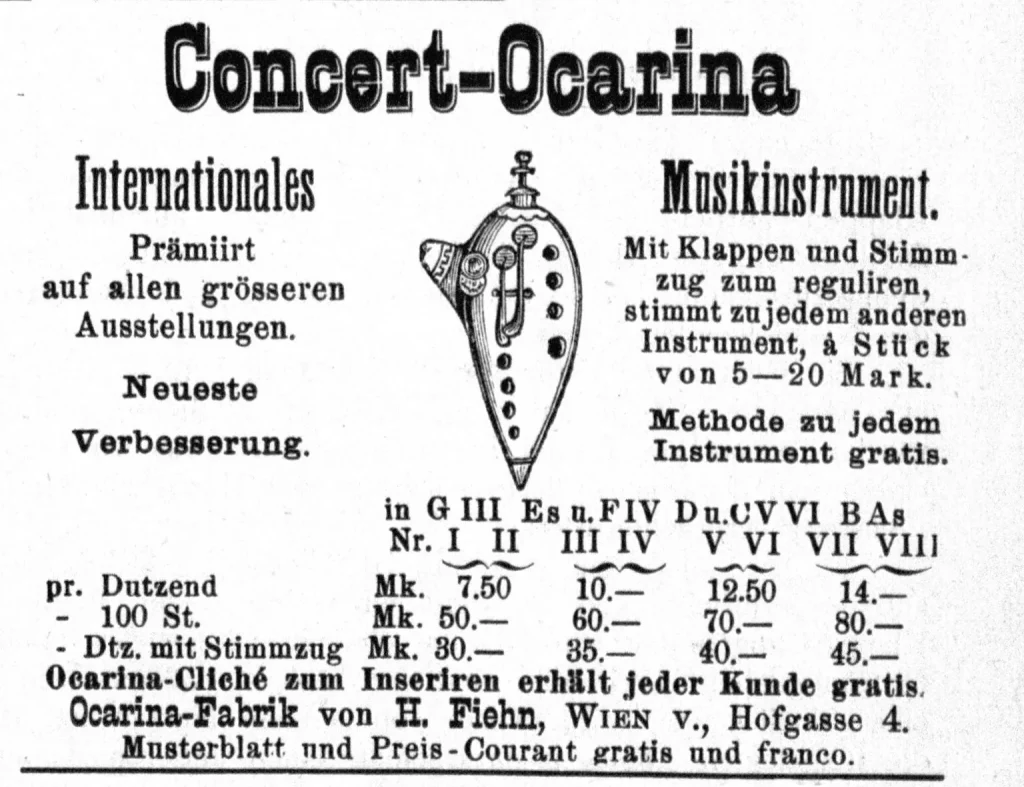
A small aerophone with a gentle tone, this instrument shaped from clay and metal has endured for centuries. Its origins reach back to ritual vessel flutes in the Americas and Asia. They reveal a striking continuity between prehistoric objects and modern forms.
Italian standardization in the nineteenth century established a playable, egg-shaped form. Its name evokes a “little goose”, and its outline has become part of the ocarina’s identity. Carried by makers and ensembles, it spread across Europe and then the world.
This chapter sets the scene: origins across continents, changing materials, variations in shape, and musical repertoires. It also traces the steps that led to a popular, accessible form in 1853.
To learn more about the instrument’s roots and spread, read this study of the origins of the ocarina. We will then return to Budrio, the makers, and the ensembles that shaped its history.
The origins of the ocarina: from ancient vessel flutes to early terracotta forms
The earliest vessel flutes appeared as both practical and symbolic objects in many cultures. They reflect an ancient creativity in which shaped clay became a source of sound and meaning.
In Mesoamerica, richly decorated clay ocarinas were often used in ceremonies. The Maya and Aztecs made a variety of examples, sometimes in animal shapes and sometimes reserved for elites.
For example: the Chibcha people of Colombia are associated with the spread of clay vessel flutes, and possibly gold ones. In Peru, some examples have as many as eight holes, showing an interest in notes and range.
In Asia, the Chinese xun, several thousand years old, and the sänshoiku of the Jōmon period show a relationship in instrument design. These ceramic aerophones share the same acoustic principle as American vessel flutes.
In Europe and Africa, remains such as the Neolithic object from Runik, along with finds in Romania and Africa, show the use of clay, stone, and bone, as well as animal shapes.
- Materials: clay, terracotta, stone, bone.
- Shapes: spheres, ovals, stylized animals.
- Uses: rituals, music, objects for elites.
In short: these varied origins reveal a world in which music took shape in simple yet expressive flutes, anticipating modern forms. To explore these origins further, read about the origins of the ocarina.
History of the ocarina: from Budrio to Giuseppe Donati
In 1853, a small town near Bologna gave rise to an ocarina design that changed the instrument’s musical standing.
1853 — the birth of a compact instrument
Giuseppe Donati developed a compact, tuned model. Its shape was oval, resembling a goose’s head, and its production in clay became more controlled.
Standardization: shape, mouthpiece, and holes
The mouthpiece became more effective, and the placement of the holes made tuning more consistent. This arrangement expanded the range of available notes.
Its name, spread, and success
The name comes from the local dialect, underscoring the instrument’s roots in the town. The founding of the Gruppo Ocarinistico Budriese in 1864 gave structure to its performance tradition.
The musician and maker gained renown; years of refinement established the modern ocarina as a reliable instrument for players and ensembles.

| Year | Event | Impact |
|---|---|---|
| 1853 | Tuned, sturdy model | Accurate pitch and ensemble playing |
| 1864 | Founding of the Gruppo Ocarinistico | Spread across Italy and Europe |
| Late nineteenth century | Standardization of the shape | Broader access for musicians |
From the modern ocarina to twentieth-century innovations
Makers developed numerous versions of the instrument to meet musicians’ needs. The twentieth century brought transverse models, double-chamber ocarinas, and versions with multiple chambers.
Variations and ergonomics: the transverse shape makes hand positioning easier, double chambers increase the range, and additional holes expand the available notes. For example, the angle of the mouthpiece, the weight, and the arrangement of the chambers can improve comfort and ensemble playing.
Materials and design: ceramic and terracotta preserve the classic tone. Metal and plastic offer durability and affordability, while geometric shapes refresh the instrument’s appearance.
Thanks to the Internet, learning and the sharing of repertoires, from traditional music to video game music, have accelerated. Workshops and brands have improved quality, expanding the instrument’s use on stage and in studios.
For more, read this overview of the instrument’s origins and development in the dedicated study.
Worldwide spread, musicians, and popular culture
The ocarina left its Italian workshops to become a recognized instrument on stages around the world.
Local ensembles played a key role: the Gruppo Ocarinistico Budriese showed how musicians could introduce the ocarina to audiences beyond their town. These groups gave structure to its performance tradition and helped it spread across Europe.

From local circles to schools and battlefields
In the United States, soldiers adopted the instrument in the twentieth century. It also found a place in classrooms from the 1950s onward, sometimes under the nickname sweet potato.
Its success in education brought the ocarina alongside other flutes and teaching instruments. Amateur musicians and teachers added it to simple repertoires and popular melodies.
Popular culture and new audiences
In 1998, the video game The Legend of Zelda: Ocarina of Time introduced a generation to the ocarina’s name and wistful tone. Media exposure brought the instrument to a wider audience.
Ensemble players and soloists now use it in concerts, films, and multimedia performances. Growing online communities connect makers, players, and audiences. A breath from the past offers an accessible overview for curious readers.
| Context | Period | Impact |
|---|---|---|
| Gruppo Ocarinistico | 1864 → nineteenth century | Spread across Italy and Europe |
| Military and classroom use | Twentieth century | Popularization in the United States |
| Video game | 1998 | Renewed media interest among young people |
Chronology, instrument design, and musical forms
A timeline helps show how technical adjustments transformed the instrument’s musical possibilities.
1853: Giuseppe Donati established a stable 10-hole model suited to ensemble playing.
Holes, notes, and range: from Donati’s 10-hole model to Aketagawa’s 12-hole model in 1928
In 1928, Takashi Aketagawa added two small upper holes, bringing the total to 12. This change increased the number of available notes and simplified some fingerings.
The holes affect the relationship between air volume and pitch. Precise control of the mouthpiece and the initial attack helps refine intonation.

Performance and repertoire: from popular music to contemporary melodies
From the nineteenth to the twentieth century, Budrio, followed by Japan with Nomura Sōjiro in 1986, and North America broadened the instrument’s use.
Musicians draw on this potential in popular music, concert pieces, and contemporary arrangements. Comparison with other vessel flutes reveals a distinctive shape and acoustic character that give the ocarina its status as a unique instrument.
| Year | Development | Impact |
|---|---|---|
| 1853 | 10-hole model | Accurate pitch and ensemble playing |
| 1864 | Founding of the Gruppo Ocarinistico | Spread through group performance |
| 1928 | Aketagawa’s 12-hole model | Extended range |
| 1986 | Popularization in Japan | Melodies heard through the media |
Conclusion
Simple in shape, this instrument offers a surprisingly rich range of sounds. Its origins on several continents and its standardization in nineteenth-century Italy shaped a clear, recognizable identity.
Milestones in its design — the move to a 10-hole model and then to a 12-hole model in 1928 — extended its range and improved pitch accuracy. These advances allowed for more nuanced melodies and stronger ensemble playing.
Among vessel flutes, the ocarina retains a distinctive shape and a sound all its own. Today, it has a place in traditional repertoires, contemporary compositions, and popular music.
To explore its history and cultural impact further, read this overview of this influential instrument and its place in music.