
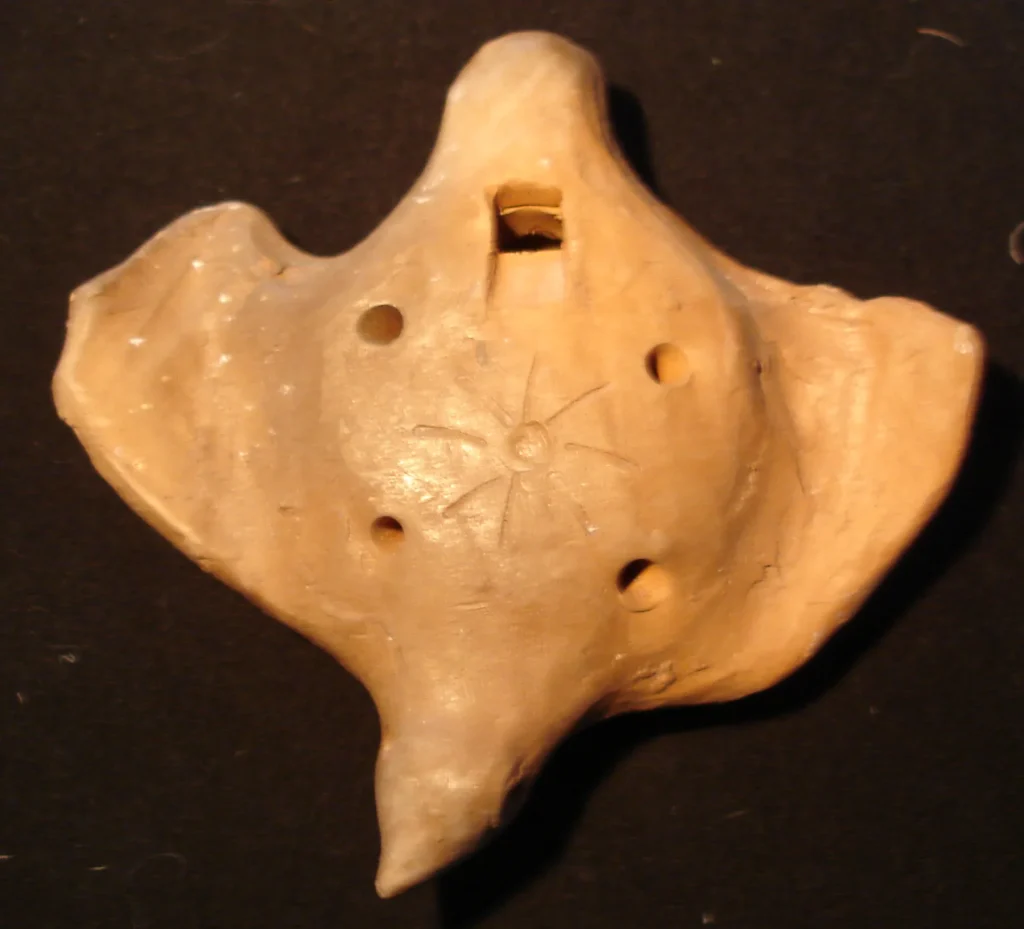
The ocarina is an egg-shaped vessel flute with a mouthpiece. The breath splits against an edge and resonates in an enclosed chamber. This chamber determines the resonance and tone, often described as soft and ethereal.
The player blows steadily into the mouthpiece and produces notes by opening or closing the finger holes. This principle is similar to that of a recorder, but the instrument’s geometry is different.
Models range from pendants with 4 to 6 holes to transverse models with 10 to 12 holes and versions with multiple chambers. Traditional materials include terracotta and ceramic, but models are also made of wood, plastic and metal.
In this article, we will explain the acoustics of a Helmholtz resonator, trace the history from Donati in 1853, discuss ranges such as Alto C, offer buying advice for France and explore current uses. Accessible, portable and affordable, the instrument lets players learn expressive melodies through logical fingerings and controlled breath.
A simple definition of the ocarina and what this guide covers
Classed as a duct vessel flute, this instrument directs air toward an internal edge, causing the egg-shaped chamber to vibrate and produce a note.
The basics: the chamber is enclosed; only the mouthpiece passage and finger holes connect it to the outside. By opening or closing the holes, the player adjusts the pitch.
Common models have 4 to 12 holes. The number affects the range, the fingerings to learn and how easily the instrument can be played in tune.
Unlike a tubular recorder, it has no long air column: resonance comes from its internal volume. Breath control and fingerings are relatively easy to master, while the tone is more consistent.
Getting started: rest the mouthpiece lightly against your lips and seal the holes with the pads of your fingers. Steady breathing and a relaxed posture help produce a stable sound.
This guide offers clear pointers for understanding, choosing and playing with confidence: basic terms, quality criteria and tuning advice for your first pieces.
Acoustics and tone: from the Helmholtz resonator to controlled breath
The mouthpiece and edge work together to turn breath into a steady vibration inside the chamber. The physical principle is that of a Helmholtz resonator: the chamber works like a bottle that sings when you blow across it.
How air, the mouthpiece and the edge create vibration
The air jet reaching the voicing window splits at the edge. This interaction makes the air in the chamber oscillate and produces clear notes.
Egg-shaped form, volume and tuning
The shape and volume of the internal chamber determine the fundamental frequency. A well-made ceramic body keeps the voicing window stable and improves tuning throughout the range.
Open holes, breath and sound level
Each open hole changes the mass of air set in motion and raises the pitch. Blowing too hard alters the attack and causes squeaks; blowing too softly weakens the resonance.
- Tone: soft and even, with fewer overtones than a tubular flute.
- Volume: about 70 dB during normal playing, suitable for practice at home.
- Tip: check tuning with a tuner while holding long notes, then check each fingering and make sure the holes are fully covered.
Origins and history: from prehistory to Giuseppe Donati in 1853 and the 20th and 21st centuries
Sound-producing pottery and musical figurines attest to very ancient uses. Found in Mesoamerica and the Andes, these objects served both rituals and everyday life.
Ancient traces in Mesoamerica, the Andes, Europe and Asia
Simple instruments producing 2 to 6 notes appeared among the Maya, Aztecs and Incas. Related objects have also been found in Europe, notably at Runik in Kosovo, while Asian instruments in the same family include the xun.
Standardization in Italy: the “little goose” and the ten-hole, then twelve-hole, model
In 1853, in Budrio, Giuseppe Donati developed a 10-hole model made of clay and ceramic. This step transformed a popular toy into a recognized instrument.
Takashi Aketagawa, worldwide adoption and the modern revival
During the 20th century, the instrument evolved toward 12-hole models and more reliable ergonomics. Takashi Aketagawa formalized these improvements in Japan around 1928.
- Spread: from Italy to Japan, China, the United States and the rest of Europe.
- Materials: terracotta and ceramic favored for the resonating chamber.
- Revival: media and video games renewed interest in the 1990s and 2000s.
| Period | Region | Characteristic |
|---|---|---|
| Prehistory | Mesoamerica, Andes | Sound-producing pottery with 2 to 6 notes, used in rituals |
| 19th century | Italy (Budrio) | Giuseppe Donati: 10-hole model made of terracotta and ceramic |
| 20th century | Japan & worldwide | Shift to the 12-hole model, standardization and worldwide adoption |

What Is an Ocarina? Definition and Uses
Today, the instrument is used both in introductory music education and in informal music-making.
Current uses: learning, expressive melodies, ensembles and playing on the go
Uses: it serves beginners, ear training and the performance of simple melodies. Its size makes it convenient for playing while traveling and practicing outdoors.
Playing experience: the mouthpiece feels comfortable right away. Breath should remain gentle and controlled to keep notes stable. Accessible fingerings make it possible to play lyrical melodies within the first few days.
Ensembles: some musicians enjoy playing it in duos or trios. Its moderate volume, about 70 dB, lets it accompany a voice or guitar at home.
Common ranges and keys: soprano, alto, tenor and bass
The instrument family ranges from high-pitched soprano to low-pitched bass. Alto C remains a versatile model, often recommended for its tuning and middle range.
- Models: 4 to 6 holes for beginners, 10 to 12 holes for a fuller range, and multiple chambers for an extended range.
- Applications: nursery rhymes, film and video game themes, world music and small-ensemble arrangements.
- Learning path: start with long notes, then move to simple phrases to strengthen your breathing and memorize finger positions over the holes.
“Its compact size and ease of playing helped a whole generation discover the instrument through the media.”
Accessibility: affordable plastic models sit alongside handmade ceramic pieces with a richer tone. Workshops and clubs encourage progress and the enjoyment of playing together.
Types and models: 4, 6, 8, 10 or 12 holes, inline, transverse and multi-chambered
The variety of models depends first on the arrangement of the holes and the shape of the instrument.
Overview:
- compact pendants with 4 to 8 holes, very easy to carry;
- 10-hole inline models, chosen for their compact size;
- 10- or 12-hole transverse models, commonly used onstage for their projection and stability.

The 12-hole alto: a versatile model
The 12-hole alto covers nearly two octaves with consistent fingerings. It makes learning easier by balancing tuning, range and logical fingerings.
Double, triple and quadruple models
Multi-chambered models—doubles with about 17 notes, triples with about 21 and quadruples with about 24—add registers without requiring a change of instrument. They allow quick shifts between octaves.
“Choosing a model depends as much on the range you want as on comfort and repertoire.”
| Type | Number of holes | Use |
|---|---|---|
| Pendant | 4 to 8 | Learning, easy to carry |
| Inline | 10 | Travel, compact size |
| Transverse | 10 to 12 | Stage, ensemble, varied repertoire |
Materials: plastic for beginners, wood for a warm tone, and ceramic for a rounded sound. Try the instrument for comfort, especially the spacing and diameter of the holes, to ensure a secure grip and clear note articulation.
Materials and construction: terracotta, ceramic, wood, plastic, metal—and tone
The materials and finish give each model its own sound.
Tone by material: ceramic offers a rounded, precise sound and pleasing resonance. Wood gives an organic warmth but remains sensitive to moisture. Plastic stands out for its durability and clear attack. Metal, which is less common, offers greater projection and a brighter tone.

Construction, mouthpiece and holes
The quality of the mouthpiece and internal whistle determines how notes begin. Clean edges improve the instrument’s response to breath.
Even, well-aligned holes help keep notes in tune throughout the range. Check that your fingers can seal each hole before buying.
Comfort, size and care tips
Shape and size affect grip and fatigue. A larger model requires a wider finger spread.
- Choose plastic when starting out or playing while traveling.
- Choose ceramic or terracotta for a rich tone, whether recording or playing in a duo.
- Choose wood if you want a distinctive tone and can give it the care it needs.
| Material | Tone | Advantage |
|---|---|---|
| Terracotta | Rounded, warm | Good resonance, handcrafted construction |
| Ceramic and porcelain | Precise, balanced | Reliable model for recording |
| Wood | Organic warmth | Lively sound; requires care |
| Plastic | Dry, clear | Durable, easy to carry |
| Metal | Bright, projecting | Strong projection for stage use |
Checks before buying: inspect the voicing window, test the tuning in the low and high registers, and make sure the surface is not slippery. For more advice on choosing a model, see this complete guide.
Choosing your first ocarina in France: comfort, budget and tuning
To choose your first instrument, start by checking how it feels in your hands. Body size, hole spacing and hole diameter affect finger accuracy and sound quality.
Grip, number of holes, size and finger comfort
For learning, a 6- or 12-hole Alto C offers a good balance between simplicity and the range of music you can play.
Test its comfort: if your fingers cannot cover the holes without strain, your posture and breathing will suffer.
Price ranges, pitfalls and tuning checks
Indicative budget: €15 to €40 for a beginner-friendly plastic model and €40 to €100 for a quality ceramic model. Handmade terracotta pieces and multi-chambered models cost more.
- Essential checks: a clean mouthpiece, aligned holes and a consistently shaped chamber.
- Test the tuning with a tuner while holding long notes.
- Avoid extremely cheap offers: they often conceal tuning defects.

“Prioritize comfort: a model that feels good in your hands helps you progress faster.”
Learning to play: posture, breath, mouthpiece and note progression
Adopting a stable posture makes breath control and accurate fingering easier. Keep your back straight and shoulders relaxed, then place the mouthpiece against your lips without pressing. This position supports airflow and prevents tension.
Steady breath, long notes, legato and articulation
Breathe in through your nose, exhale gently and control your breath to sustain steady notes. Start with the lowest note, with all holes covered, and hold it for a long time.
Alternate legato, with continuous airflow, and staccato, with a brief break, to practice articulation and vary your melodies.
Vibrato, trills and finger dexterity for greater expression
Practice vibrato with slight changes in breath intensity or small finger movements. Practice trills between neighboring notes with a metronome, gradually increasing the speed.
- Cover the holes: use the pads of your fingers to make a complete seal.
- Record your practice sessions to assess tuning and tone.
- Routine: several short daily sessions are better than one long session.
“Starting with simple melodies helps stabilize the scale and speeds up progress.”
The ocarina in popular culture: video games, cinema and world music
A video game made this instrument an icon for several generations. The Legend of Zelda: Ocarina of Time, released in 1998, sparked worldwide interest and forged a strong link between popular culture and music-making.
The Legend of Zelda and the contemporary rise of the ocarina
Its 1998 release increased demand for lessons, inspired new players, and prompted tutorials and covers. Video games provided a springboard, while online communities made tablature easier to find.
From folk traditions to today’s stages: repertoire and collaborations
In cinema, Vladimir Cosma used a bass ocarina in Alexandre le Bienheureux, released in 1967. The instrument’s distinctive tone also finds a place in Andean, Celtic and Asian music.
- Tradition and modernity: Giuseppe Donati’s legacy, Japanese innovations and multi-chambered models.
- Community: YouTube channels, dedicated ensembles and projects bringing together orchestras and folk groups.
- Versatility: from intimate solos to arrangements, its range allows memorable melodies despite its small number of holes.
“A cultural symbol where heritage meets contemporary creativity.”
Conclusion
Conclusion
Its charm comes from the meeting of controlled breath and a shape that focuses vibration. This instrument remains an approachable vessel flute whose resonating chamber produces a soft tone.
To begin, choose a well-tuned 12-hole alto: it offers reliable tuning, a comfortable range and room to progress. Check the grip, how well the holes seal and the finish of the mouthpiece.
For materials, choose ceramic or terracotta for a rounded sound, plastic for durability or wood for a distinctive tone. Its moderate volume suits playing at home or in a small ensemble.
In practice, adopt a relaxed posture and work on long notes, then articulation, vibrato and trills. Explore different models, practice regularly and let this wind instrument become a lasting musical companion.