

Discover a clear, progressive learning plan to get started today in France. This guide offers concrete goals for each level and brief instructions for every practice session.
You will learn to steady your breath, hold the instrument, and coordinate your fingers with your breathing. Each exercise prepares you for the next: warming up, sustained notes, then rhythms and melodic variations.
Measurable results: a steadier sound, cleaner transitions, and phrases that sound in tune. The step-by-step format makes it easy to practice for 10 to 20 minutes a day without feeling overwhelmed.
Getting started with the 6-hole ocarina today
Start with a stable posture to make breathing easier and improve your control. Keep your back straight, your shoulders relaxed, and your elbows slightly away from your body to breathe deeply and evenly.
Holding the instrument and placing your fingers
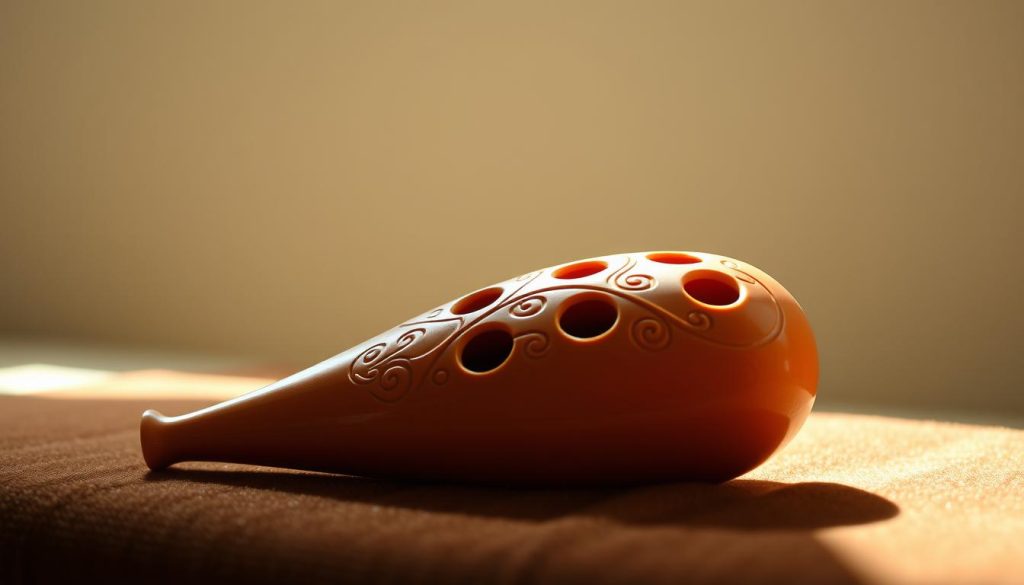
Let the instrument rest naturally in your hands. Your fingers should cover the holes gently, without pressing down. Use the pads of your fingers rather than your fingertips to seal the holes and make clean transitions.
- Let the instrument sit naturally in your palms.
- Seal the holes completely without pressing hard.
- Check your finger positions by sight at first, then close your eyes to memorize them by touch.
Breathing and starting each note
Practice abdominal breathing: inhale slowly, letting your belly expand. Then blow with steady, moderate pressure.
Start each note with a gentle “ta” articulation to avoid a harsh burst of air. Avoid blowing too hard: find the pressure that produces a clear sound without strain, especially on high notes.
Recommended practice: repeat slow transitions between two finger positions while keeping the same air pressure. Record short passages and leave a comment to identify where you are improving. To get started, establish a daily warm-up routine of 2 to 3 minutes.
6-Hole Ocarina: Progressive Exercises
Begin by playing slowly up and down the scale to coordinate your breath, fingering, and ear.
Very easy warm-up: ascending and descending scale
Play the full scale at a slow tempo. Aim for even notes and steady breath.
This prepares your intonation and finger memory for the exercises that follow.
Breath control: sustained notes and dynamics
Hold each note for 4 to 8 seconds, first at mezzo-forte, then alternating between piano and forte.
Keep the airflow steady to prevent changes in pitch.
Coordinating fingers and breath
Practice alternating pairs of holes (for example, 1 and 4, 2 and 5, 3 and 6) to make changes smoother.
This helps prevent audible air leaks and makes transitions more precise.
Rhythms and melodic variations
Practice sequences of quarter notes, then legato eighth notes and simple syncopations. Keep your breath steady.
Create short phrases of 4 to 6 notes, then add small leaps to expand your musical vocabulary.
Advanced challenge: double tonguing and triplets
Practice the double-tonguing pattern “ta-ka” in groups of 4 notes, then 8 notes, at a moderate tempo.
Next, introduce triplets. Play them in legato first, then with double tonguing.
| Step | Duration | Goal | Measure of progress |
|---|---|---|---|
| Slow scale | 2 to 3 min | Intonation and finger memory | Even notes |
| Sustained notes | 3 to 4 min | Control of dynamics | Steady notes held for 4 to 8 s |
| Finger alternations | 3 min | Smooth transitions | No air leaks |
| Articulation and triplets | 2 to 3 min | Rhythmic clarity | Clear “ta-ka” articulation and triplets |
Recap: finish with a 2- to 3-minute passage combining a scale, sustained notes, finger alternations, rhythm, and articulation.
Putting it into practice and getting feedback: tablature, comments, and motivation
Start with a simple score: the “6-hole scale” tablature (Sheet Music > Other), created by root699 on 22/05/2024, is rated Very easy. It is ideal for warming up and lets you check your intonation as you ascend and descend.
An example of an easy piece
Next, add an enjoyable piece: “OoT – Song of Storms (6-Hole Ocarina),” posted by Tgev on 07/05/2013 in C. Its listed difficulty, “None,” makes it ideal for practicing phrasing, triplets, and double tonguing in a musical setting.
Tracking your progress and taking part
Structure your sessions: spend 5 minutes on the scale, 10 minutes on the piece, then 5 minutes consolidating what you have learned. Record the tempos you reach, the notes you can hold steadily, and any finger changes that still feel uncertain to track your progress from week to week.
- Check the engagement figures: the scale has 0 likes and 0 comments; Song of Storms has 1 like and 0 comments.
- Sign in to rate the tablature and leave a constructive comment if the platform requires it.
| Score | Author | Date | Difficulty |
|---|---|---|---|
| 6-hole scale | root699 | 22/05/2024 | Very easy |
| OoT – Song of Storms | Tgev | 07/05/2013 | None |
Conclusion
You now have a simple, practical plan for structuring your daily practice. Posture, finger placement, breath, and the exercises (scales, sustained notes, coordination, rhythms, variations, and double tonguing) provide a clear foundation.
Keep your routine short but regular: 15 to 20 minutes is enough to steady your tone, refine your intonation, and play rhythms more comfortably without tension.
Reinforce what you have learned by connecting each exercise to a real piece: start with “6-hole scale,” then move on to “Song of Storms” to practice phrasing, dynamics, and articulation. To explore the fundamentals further, see basic techniques for beginners.
Assess your own progress against clear goals, move forward one step at a time, and share useful comments on tablature to stay motivated and exchange tips.