

A small component bears a heavy load. The bridge supports the total string tension, estimated at 50 to 70 kg. Each string transfers its force to the soundboard. Regular inspection helps you spot a lifting bridge, a crack or unusual movement early.
The soundboard, often made of spruce or cedar, acts like a miniature loudspeaker. String vibrations shape the instrument’s projection, sustain and dynamics. A stable bridge therefore helps preserve a clear sound.
Keeping relative humidity between 45 and 55% helps prevent cracks and wood distortion. Gentle cleaning with a clean cloth also protects the finish. This preventive care preserves the instrument’s value and resonance.
This guide offers a clear way to check the saddle, action and intonation without unnecessary jargon. A few checks after each playing session can extend the instrument’s life. See our guide to adjusting the bridge as well.
This approach helps beginners and enthusiasts alike. It improves the experience of playing French guitars and gives blog readers simple, reliable steps they can put into practice.
Acoustic Guitar Bridge: Function, Adjustment and Maintenance
In an acoustic guitar, each part guides the energy produced by a string. That energy passes through the saddle and bridge to the soundboard, then through the guitar body. The nut defines the other end of the vibrating string. Together, these parts support clear, consistent vibrations.
How the bridge, saddle and nut transmit vibrations
Scale length is the vibrating length between the nut and the string’s contact point at the bridge. The right height provides suitable action, protects the neck and makes the guitar more comfortable to play. The wood can then receive vibrations steadily, with minimal energy loss.
- The saddle transfers the strings’ pressure precisely.
- The nut keeps the strings in position over the fingerboard.
- The bridge distributes tension across the guitar body.
Effects on intonation, projection and playability
At the twelfth fret, compare the harmonic with the fretted note. A difference indicates imperfect intonation. Careful adjustment improves projection, tuning accuracy and comfort.
A full inspection each year helps prevent lasting problems.
xlguitares has made this recommendation since January 14, 2021. To extend your instrument’s life, see our guitar maintenance guide as well.
Recognizing a poorly adjusted or weakened bridge
A visual check often reveals a problem before it becomes serious. On a guitar, a bridge lifting by more than 1 mm is a warning sign. It calls for a professional inspection, because string tension can make the movement worse.
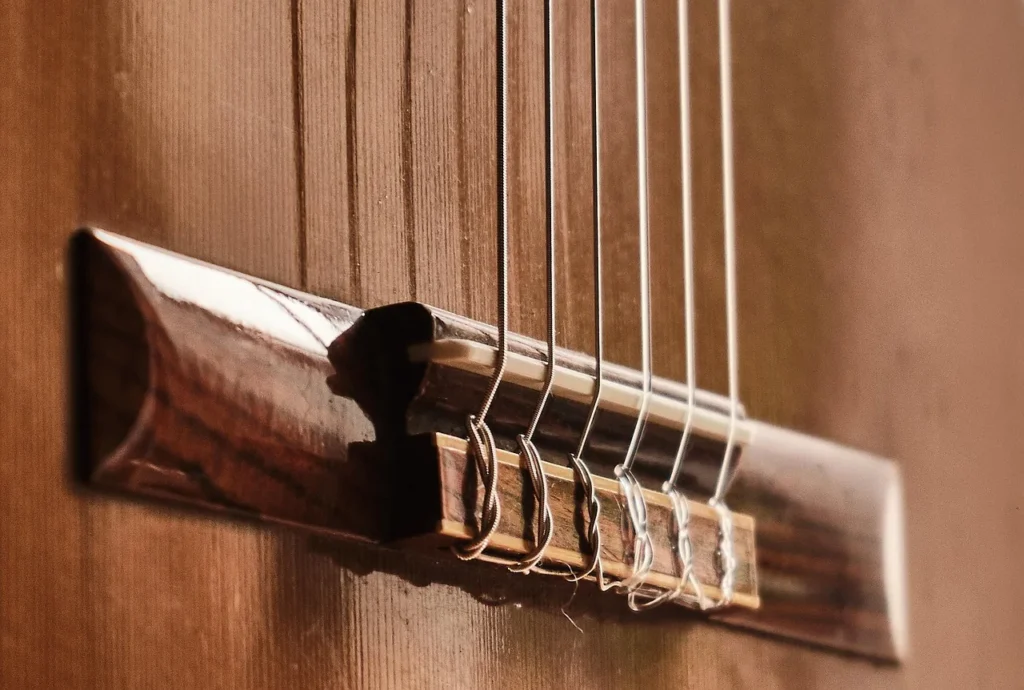
Lifting, cracks, unwanted vibrations and unstable tuning
After slightly loosening the strings, slide a thin card beneath the bridge. It should move without being forced. Do not press on the wood. A crack near the bridge, a bulging soundboard or unusual vibrations also call for a specialist’s opinion.
- A change in height can affect the action, playability or intonation.
- Unstable tuning may stem from the bridge, neck, nut or tuning machines.
- In these cases, record the signs you notice, the surrounding humidity and how they change over time.
Visible movement calls for prompt attention, never an improvised glue repair.
Cleaning with a cloth is safe before any repair. If the bridge really moves, a luthier may use Titebond glue and then adjust the saddle. This care helps protect the instrument over the long term.
Preparing to adjust action and intonation
Before making any changes, place the instrument on a stable surface. Tune the strings, then note the surrounding humidity. This gives you a reliable starting point for each measurement.
Checking neck relief and string height
Press each string at the first and then the fourteenth fret. Neck relief should not exceed 0.5 mm. At the first fret, aim for 0.2 to 0.3 mm after pressing the string at the third fret.
- Turn the truss rod in quarter turns.
- Keep the strings under tension and in tune.
- Check the neck after every adjustment.
A guide to adjusting a guitar neck can help you avoid a costly mistake. Do not make adjustments if the nut, saddle or bridge is damaged.
Measuring action at the twelfth fret
Place a gauge between the underside of a string and the top of the fret. On a steel-string acoustic guitar, allow 2.5 mm on the high E side and 3 mm on the low E side. On a classical guitar, aim for 3 mm and 4 mm respectively.
Comparing the harmonic with the fretted note
At the twelfth fret, use a tuner to compare each harmonic with its fretted note. A note that is too sharp or too flat indicates that the intonation needs correction. Each saddle contact point then needs a careful check, without abrasive tools.
Measure first: a small change can greatly affect playability.
Adjusting the bridge and saddle carefully
Precision begins with a measurement, never a guess. To lower the action, remove the strings, mark the current height, then take the saddle out of the bridge without forcing it.
Sand its underside very slowly on a flat surface. Preserve its fit and orientation. A light pass is often enough. Put it back, restring the guitar, then check each string with a tuner.
- Too little height can cause fret buzz.
- Too much height makes the guitar difficult to play.
- An uneven base reduces sound transmission.
Patience protects the instrument. For a complete method, see this setup guide. Adjust the neck in quarter turns, with the strings under tension and in tune.
On an electric guitar, nearly 95% of models allow the height and intonation of each saddle to be adjusted. Tune-o-matic bridges, tremolos and Floyd Rose bridges have dedicated adjustment screws. If the fretted note sounds sharper than the harmonic, move the saddle backward, then check the vibrating string length.
Check the fingerboard radius, alignment, humidity and contact points. A loose bridge or poorly fitted saddle requires a luthier’s experience. For routine care, follow this maintenance guide as well.

Caring for the bridge, soundboard and strings every day
A simple routine preserves the guitar’s response, string height and action. After each playing session, wipe the soundboard, bridge, strings and back of the body with a dry microfiber cloth. This habit limits the buildup left by perspiration.

Cleaning with a cloth and protecting against humidity
Acidic perspiration speeds up string corrosion. It also leaves grime on the fingerboard, frets and nut. When cleaning, avoid alcohol, solvents and silicone: these products can dull the finish, mark the wood or leave a film.
Keep relative humidity between 45 and 55%. An Humidipak can be used inside the case without touching the guitar body directly. Keep the instrument away from radiators, sunlight, sudden changes and water.
- A small amount of suitable oil may be used on an unfinished fingerboard.
- A finished maple fingerboard does not need this treatment.
- For reliable adjustments, see Guitarstore’s guitar care advice.
A gentle daily routine protects the sound for longer.
Conclusion
A stable bridge, a well-fitted saddle and a checked neck preserve intonation and playing comfort. On an acoustic guitar, measure the action at the twelfth fret. Compare the harmonic with the fretted note to check intonation.
Every string needs regular care. Gentle cleaning protects the fingerboard, finish and body. Monitor humidity too, ideally keeping relative humidity between 45 and 55%. This habit limits cracks, distortion and wear over time.
If the bridge lifts by more than 1 mm, moves or needs structural adjustment, consult a luthier. The right tools help prevent mistakes affecting the saddle or neck. Our maintenance guide helps you plan adjustments. An annual inspection, recommended by the xlguitares blog on January 14, 2021, helps keep your guitar ready to play.