
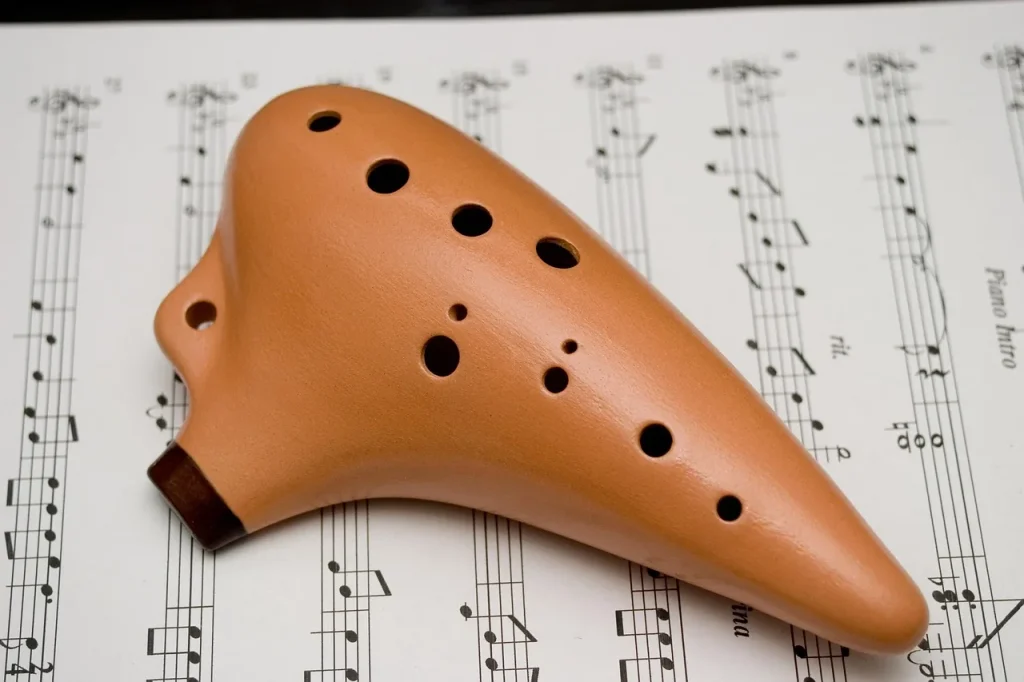
This buying guide helps you choose according to your skill level, budget, available time, and musical goals.
We cover three families based on their number of holes and typical uses for beginners and for intermediate and advanced players.
Choose specialist sellers such as STL Ocarina, Musique de Terre, or Focalink/Stein. Low-priced models sold on Amazon, Wish, or AliExpress are often poorly tuned and can hinder progress.
For a first ocarina, the general recommendation is a 12-hole model: it covers approximately 21 to 22 notes and makes it easier to learn popular melodies.
A 4- or 6-hole instrument can still suit very young beginners or people with small hands, but it imposes playing limitations.
Next, we will examine the key criteria: range, tuning, materials, ergonomics, build quality, brands, and where to buy.
To compare the options and see how notes are distributed across the different types, follow this useful link: hole counts and note ranges.
Why the number of holes matters for your first instrument
The number of holes greatly affects what you can play and how quickly you learn. For a wind instrument, their arrangement influences range, intonation, and handling.
Common mistakes to avoid with inexpensive marketplace models
General sellers offer attractive models, but they are often poorly tuned. Common problems include:
- poorly made mouthpieces;
- misplaced holes that disrupt the fingerings;
- an inability to produce consistently accurate pitch (A440).
In practice, these problems cause frustration. A common example is a cheap “Zelda” ocarina whose high notes are almost unplayable. Motivation can quickly fade.
Effects on range, intonation, and ease of learning
More holes provide a wider range and easier access to sharps and flats. For beginners, that makes it easier to play popular melodies and video game themes.
A well-tuned 12-hole model has progressive fingerings: the fingers lift one after another. This makes it easier to learn than certain 6- or 8-hole models whose fingerings require more memorization.
Practical tip: check quality controls, whether a tuning certificate is provided, and customer reviews from reputable sellers. To compare hole counts and note ranges, see our guide to holes and notes.
The result: choosing a beginner-friendly model makes playing easier from the first few weeks and supports your musical progress.
Which ocarina should you choose: 4, 6, or 12 holes?
Start by assessing how many notes are available and how that will help you progress. The number of holes determines the range, the fingering pattern, and the recommended skill level.

At a glance: playable notes, range, and recommended level
Here is an overview:
| Configuration | Approximate number of notes | Range | Recommended use |
|---|---|---|---|
| 4 holes | 8 to 9 notes | Limited | Children, early music learning |
| 6 or 8 holes | 17 to 18 notes | Moderate | Memorization-based playing (John Taylor system) |
| 10 or 12 holes | 21 to 22 notes | About 1.5 octaves | Beginners and popular melodies |
Beginners and small hands
For beginners, a 12-hole transverse model is often easier. Its fingerings follow a progressive pattern: lift one finger to move up a note. This makes playing intuitive and reduces frustration.
The John Taylor system offers many notes, but it relies on less obvious combinations. For very young players or people with small hands, choose a compact model: its light weight and ergonomics make it easier to hold.
In short: most beginners benefit from starting with a well-tuned 12-hole model, which covers the range of common melodies and helps them learn faster.
A closer look at ocarina types: 4, 6 or 8, and 10 or 12 holes, plus multi-chamber models
Each family serves a particular purpose: early music learning, memorization-based study, melodic playing, or advanced performance.
Ultra-compact format
4-hole model: ultra-compact, it offers 8 to 9 notes across an octave. It is relatively rare and suits early music learning for very young children. In practice, it is used for simple phrases and rhythmic games.
John Taylor system (6 or 8 holes)
Six- and eight-hole models offer up to 17 to 18 notes through the John Taylor system. Learning requires more memorization; the fingerings are efficient but less intuitive.
10- or 12-hole transverse ocarina
The 10- or 12-hole format covers approximately 21 to 22 notes and makes accidentals easier to play. Donati’s legacy supports progressive fingerings and a natural chromatic ascent. The result is greater range for common repertoire.
Multi-chamber models
Double-, triple-, and quadruple-chamber models extend the range. Each chamber has its own mouthpiece opening and can take the range beyond two octaves.
- “Asian” fingerings: maximum continuity between notes.
- Pacchioni fingerings: smoother transitions and a consistent timbre, useful when moving between chambers, for example to make a subtle register change.
In summary: start with a simple 10- or 12-hole model. Move to a multi-chamber ocarina when your breath control and technique are ready.
Tuning and range: alto or “tenor” in C, G, F… understanding the keys
Tuning and range determine the low and high notes of a wind instrument. Its range indicates whether the sound falls mainly in a soprano, alto, tenor, or bass register.

Why tuning in C makes starting easier
An ocarina in C gives you direct access to the full major scale. That makes beginner tutorials and sheet music easier to follow.
Practical advantage: most methods and tablatures use C. For a first instrument, combining C tuning with a model that has many holes reduces complicated fingering changes.
Understanding AC, C3, and “Tenor in C” labels
Names vary by region: AC in Asia often corresponds to C3 in Europe. STL Ocarina uses “Tenor in C” for an alto in C, referring to the same tuning.
For example, an instrument in G shifts all the notes lower without changing the fingering pattern. Always check what these labels mean before buying online.
- Rule of thumb: choose a 12-hole model in C for easier access to accidentals (sharps and flats).
- Starting with an alto or tenor remains the most versatile solution for everyday music.
Materials and design: ceramic, plastic, and finishes
The material directly affects your instrument’s tone and durability. The right choice depends on how you plan to use it: in the studio, on stage, or on the move.

Ceramic: it offers a warm, rich tone with good projection. Glazed finishes improve note clarity and resonance. The trade-off is that ceramic is more fragile and needs careful handling.
Plastic: sturdy and light, it suits travel, lessons, and school workshops. The plastic Night by Noble model is known among instrument players for its value and stable tuning.
Finishes and design
Careful glazing improves response and projection. Shape, wall thickness, and mouthpiece design influence ergonomics and perceived intonation.
- The material does not change the number of holes, but it changes the tone and how the instrument feels when you blow.
- STL, Musique de Terre, and Focalink offer ceramic and plastic models with consistent quality standards.
- Choose a well-tuned instrument over a poorly tuned model with a fanciful design.
Tip: choose ceramic for a “studio” sound and plastic for playing on the move. The variety of models meets more needs than you might expect.
Essential buying criteria for choosing an ocarina
A good first purchase comes down to three simple criteria: budget, ergonomics, and tuning. These determine how easy the instrument is to learn and how long it will serve you.

Recommended budget and price points to avoid for accurate tuning
Avoid offers under €20. These models often have intonation problems, especially on high notes.
Aim for €35 to €60 for a reliable first instrument. This price range offers basic quality control and tuning close to A440.
Ergonomics: hole spacing, hand size, weight, and grip
Check the distance between the holes and the position of the mouthpiece. Your fingers should cover the holes without strain.
Weight and size affect fatigue. A comfortable grip improves ease of playing and helps you keep a steady breath.
Build quality: A440 tuning, high notes, and accidentals
Check that the instrument is tuned to A440 and that the seller provides audio tests.
Check the stability of the high notes and the response of the accidentals if you want to play chromatic passages.
- Reliable brands: STL, Focalink/Stein, Dinda, Musique de Terre, and Spencer; Night by Noble for plastic models.
- Read specifications, listen to audio demonstrations, and check the return policy before buying.
- Match your choice to your level and available time: a good first ocarina in C makes progress easier.
Reliable brands and models: from affordable choices to high-end instruments
Well-known options on the market can make choosing easier. Look for brands that ensure accurate tuning, quality checks, and access to learning resources.
Reliable beginner models
Dinda offers accessible handmade models (about €35 for an AC), ideal for a first ocarina. Focalink/Stein has a broad range (Alto C, approximately €42 to €89) and a worldwide reputation. Finally, STL Ocarina offers a good balance: a large catalog, certificates, and learning resources. Its “12 holes in C major” model is an excellent beginner choice.
Artisans and high-end instruments
Musique de Terre (Olivier Gosselink) makes exceptional transverse and multi-chamber ocarinas. Spencer and Pure Ocarinas cater to demanding players with luxurious finishes and distinctive tonal character.
Design and finish matter: glazing, ergonomics, and fine adjustments help produce reliable notes. For a first purchase, steer beginners toward STL Ocarina, Focalink, or Dinda, and enthusiasts toward Musique de Terre, Spencer, or Pure Ocarinas.
For a detailed comparison, see this example guide, which helps clarify confusing tuning labels.
Where to buy confidently in France and online
Buying from a specialist retailer reduces the risks and provides after-sales support. A reputable seller provides clear specifications (tuning, range, materials, and number of holes) and online learning resources.
Recommended sellers
- STL Ocarina — a large catalog shipped from the United States; delivery takes approximately 15 to 18 days, free shipping may be available above a certain order value, and customs charges are possible.
- Musique de Terre — a French maker; production takes around three weeks, with direct contact with the artisan.
- Ocarina World — a French distributor of Stein/Focalink; a good option for faster delivery after an online order.
- Songbird — a carefully chosen selection and responsive customer service.
Delivery times, costs, and precautions
Plan for the total cost: price, shipping, and taxes. For orders from the United States, allow extra time and account for possible customs charges.
Choose tracked shipping and a seller you can contact if you have a question about your instrument.
| Seller | Origin | Delivery time | Advantage |
|---|---|---|---|
| STL Ocarina | United States | 15 to 18 days | Wide selection, online documentation |
| Musique de Terre | France | Around 3 weeks | Handcrafted instruments, personal support |
| Ocarina World / Songbird | France | 3 to 10 days | Stein/Focalink distribution, local after-sales service |
Summary: buy from a specialist instead of choosing a low-priced marketplace listing. A good first ocarina bought online from a specialist supports your musical progress.
Getting started: learning resources and progress
A short, focused routine helps you progress quickly. To stay motivated, combine tutorials, daily practice, and feedback on your playing.
Recommended channels and tools
OCTalk offers structured tutorials. The STL Ocarina channel provides more than 300 videos, including lessons and demonstrations useful to beginners and developing players.
Gosselink is an ideal resource for working on musicality and advanced techniques. Part’Ocarina lets you create and find tablatures suited to your number of holes and skill level.
“Regular practice, recording yourself, and listening critically speed up improvement.”
Practice method
Practice for 15 minutes a day: C scales, note exercises, and breath control. Record your sessions to correct your intonation and posture.
Suggested progression:
- Master the C scale.
- Add accidentals and develop your ear.
- Work on high notes and a stable tone.
| Resource | Use | Advantage |
|---|---|---|
| OCTalk | Structured tutorials | Step-by-step progression |
| STL Ocarina | Videos and demonstrations | Extensive teaching catalog |
| Gosselink | Advanced techniques | Musicality and nuance |
Alternate technical exercises with pieces you enjoy. Share your playing online to get feedback. To choose your first piece of sheet music, see this resource: how to choose beginner sheet music.
Conclusion
For most beginners, the best option is a well-tuned transverse ocarina in C.
This model offers the best balance of range, simple fingerings, and accurate intonation. This instrument gives you access to common notes and helps you progress faster.
Avoid low-priced marketplace offers: poor construction can undermine motivation. Choose reliable brands such as STL, Musique de Terre, Focalink/Stein, or Dinda, and check for A440 tuning.
Allow for delivery times and costs if you buy from a distant seller. Later, once you have developed your handling and technique, the extended range of a multi-chamber ocarina will be a real advantage.
To take the next step: set your priorities, compare two or three models, and choose a reliable instrument to accompany your musical practice.