
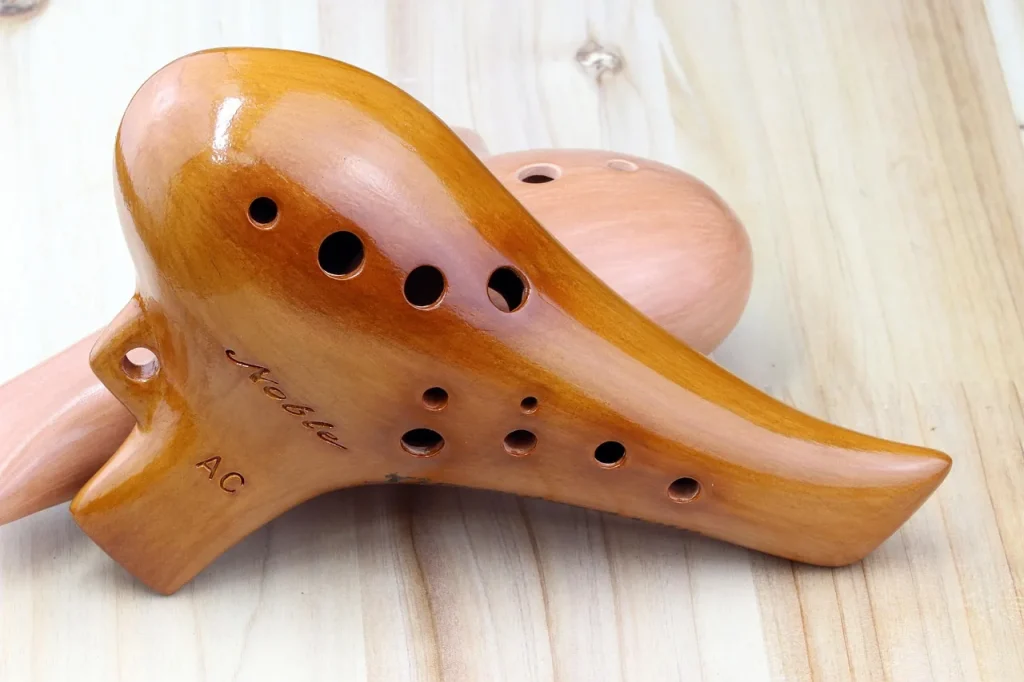
This practical guide opens up a wide repertoire and approachable melodies for beginners in France.
Goal: help you learn to play quickly with clear notation systems and a 12-hole ocarina in C, for which fingerings are widely documented.
You will learn to read the diagrams: black circles for covered holes and white circles for open holes, reading from top to bottom and then from left to right.
Rhythmic symbols—dashes to lengthen notes, multipliers to repeat passages, and horizontal braces to play in one breath—give structure to your practice.
What’s covered: ten simple songs, advice on adapting sheet music and practicing at your level, and reliable resources for finding sheet music in France.
To learn more about reading tablature, see this detailed tutorial on notation and symbols.
Learning to play the ocarina in France today: finding music and playing independently
Learning to read sheet music quickly transforms your playing. It gives you direct access to a broad repertoire, from traditional music to contemporary themes. You can choose a variety of pieces without being limited to a handful of arrangements.
Music theory remains useful as a shared language when playing with other musicians. It makes it easier to exchange arrangements and take part in group projects online or in workshops.
You become more independent through simple habits: choose a piece of music, use a metronome, and break down each phrase. This approach strengthens your timing and consistency.
Visual notation offers an accessible starting point without extensive theoretical knowledge. It develops concentration, hand-eye coordination, and working memory—skills that are useful beyond music.
- Practical tip: check your instrument’s key and range to avoid fingering mistakes.
- Resources in France: local learning materials and online communities can help you progress at your own pace over time.
Choosing a 12-hole ocarina in C for an easy start
To progress quickly, focus first on sound quality, comfort, and accurate tuning. Ocarinas come in 4-, 6-, and 12-hole models. The 12-hole model covers a wider range, and its fingerings match those used in many tutorials.
Key, range, and number of holes
Choosing the key of C reduces the need to transpose and simplifies learning the fingerings. The instrument’s range shapes its sound: soprano for a bright high register, alto for a versatile balance, and bass for a deeper register.
Comfort, tuning, and breath
The instrument’s balance, hole placement, and mouthpiece affect comfort and breath control. Check how it feels in your hands and whether your fingers seal the holes, since air leaks can blur the start of notes.
Brands recommended for beginners
- STL Ocarina, Songbird, and Night by Noble: reliable choices with stable tuning.
- Choose a well-tuned instrument so you can train your ear effectively.

Reading ocarina tablature: fingering diagrams, note lengths, and breath control
Learning to decode tablature helps you approach each fingering and breath with confidence.
Visual diagrams: the diagrams show covered holes in black and open holes in white. Read them from top to bottom, then from left to right. Locate the small rear holes near the mouthpiece and check your grip to prevent air leaks.
Beat and duration: one dash doubles the length of a note; two dashes make it four times as long. Multipliers repeat the indicated sequence without writing it out again.
Horizontal braces: these indicate that the notes should be played in one breath. Plan where to breathe between bars or spaces to preserve your pitch and phrasing.
- Match each diagram to its fingering, checking the position of your fingers at the back of the instrument for clean note attacks.
- Practice slowly with a metronome: count the beats and master the transitions before increasing the tempo.
- Repeat one pattern on its own, check your fingering, and then play the full phrase again.
Simple tablature, standard sheet music, or a hybrid: which suits your level?
The notation format directly affects how quickly you learn and how much you enjoy playing. Depending on your level, one system may make memorization and accuracy easier than another.
Simple tablature
Simple tablature uses pictograms, dashes, parentheses, and braces. It may use color to make repeated passages easier to spot.
Benefit: you can read it immediately and memorize patterns quickly. It is ideal for getting started and building confidence.
Adapted standard sheet music
Standard sheet music gives precise rhythmic information through note values, rests, ties, and repeat barlines.
It makes it easier to collaborate with other musicians and learn music theory. Practicing timing with a metronome becomes essential.
Hybrid versions (note + diagram)
Hybrid versions show the note on a staff with a small fingering diagram beneath it.
They provide a useful bridge between reading and playing: you strengthen your reading skills while checking the fingering on your instrument.
“Start with simple tablature, move on to hybrid versions, and then use standard sheet music to expand your repertoire.”
- Start with simple tablature to learn the patterns.
- Move to hybrid versions to connect notes with diagrams.
- Finish with standard sheet music to play with others and improve your timing.
- Always check the key and number of holes on your instrument so the fingerings are correct.

Adapting sheet music to your instrument: range, key, and accurate transposition
First, compare the music’s required range with your instrument’s range. Check whether your soprano, alto, or bass can play every note. If a note falls outside its range, transposing may be easier than rewriting the whole piece.
Soprano, alto, bass
Check your instrument’s range to make sure it covers the notes you need. An alto is often the most versatile choice for a wide variety of music.
Matching the music to the instrument
For instruments in the same key, fingerings remain consistent even when the sounding octave changes. Choosing a model in C makes it easier to use standard sheet music and resources available in France.
Transpose, test, and mark the music
If a note lies outside your instrument’s range, moving it by an octave is often the simplest solution. Mark these passages in pencil so you can read them without hesitation.
Try this: isolate a difficult fingering, play it slowly with a metronome until it feels secure, then put it back into the phrase. Check the duration and timing to preserve the phrasing.

- Check the range to avoid rewriting the music.
- Keep the same key to make fingerings straightforward.
- Move passages by an octave and mark problem spots.
- Plan your breaths to support the phrasing.
“Testing a passage on its own and marking where to breathe make any adaptation easier.”
12-Hole Ocarina Sheet Music: 10 Easy Songs
Start with familiar tunes to establish a steady rhythm and make memorization easier. This approach motivates beginners and helps them learn the fingerings.
Selection and progression
Beginner selections: traditional tunes and familiar themes
Choose a list of ten melodies in hybrid notation: nursery rhymes, folk tunes, and themes from games or films. Hybrid versions combine diagrams and notes to ease the transition to reading sheet music.
Step-by-step progression: nursery rhymes → folk → games and films
Organize your progress into three stages.
- Slow nursery rhymes to master timing and notes.
- European folk tunes to practice slurs and transitions.
- Pop and game themes in hybrid notation to strengthen your ability to read diagrams and notes.
Resources and examples
For sheet music organized by level, visit STL Ocarina. Create your own tablature with Part’Ocarina, and exchange ideas on OCTalk or FolkFriends to get feedback.
| Stage | Goal | Suggested resource |
|---|---|---|
| 1 – Nursery rhymes | Master tempo and notes | Simple PDFs (filetype:pdf), hybrid versions |
| 2 – Folk | Practice slurs and phrasing | STL Ocarina collections, forums |
| 3 – Themes | Read and play independently | Part’Ocarina, community feedback |
Two practical examples:
- Example 1: a simple traditional tune with few covered holes to develop consistent fingering.
- Example 2: a familiar theme with a clear rhythm to practice steady timing.
Practical tip: adapt the music to your instrument’s range and choose a model in C to make learning materials easier to use and reduce transposition. Follow the diagrams alongside the notes before playing from sheet music alone.

To find tablature in C and detailed fingering diagrams quickly, see tablature in C.
Practice routines, resources, and learning methods in France for reading sheet music and tablature
A few minutes of well-structured daily practice can bring faster progress than one long session.
Recommended short routine
5 minutes of breath work: hold steady notes to control airflow and note length.
5 minutes of fingering: practice slow transitions to reinforce patterns and muscle memory.
5 minutes of sight-reading: use a metronome, work through the melody, and check your timing.
Reliable resources in France
STL Ocarina offers sheet music organized by level. Part’Ocarina generates tablature and diagrams. Exchange ideas with other musicians on OCTalk and FolkFriends.
Tip: search for filetype:pdf ocarina to find printable collections.
Methods and songbooks
Ocarina Method Book 1 and beginner collections often include metronome guidance. They offer a progressive approach that you can follow over time.
Common mistakes and how to correct them
Check that the key of the music matches your instrument. Read the legend again to avoid confusing dashes with multipliers.
If air leaks, check your finger placement and mark where to breathe. Record yourself and compare your playing with a reference to improve note lengths and articulation.
| Resource | Use | Benefit |
|---|---|---|
| STL Ocarina | Organized sheet music | Selection by level |
| Part’Ocarina | Tablature generator | Custom diagrams |
| OCTalk / FolkFriends | Discussion forums | Feedback from other musicians |
To choose a suitable instrument and avoid mistakes with the key, read this guide on which ocarina to choose.
Conclusion
Three things drive progress: a well-tuned instrument, steady rhythm, and clear notation. Choosing a well-tuned model in C, practicing with a metronome, and following a progressive method help you learn faster.
Start with hybrid versions to connect the physical movements with the notation. Use simple tablature first, then move on to standard sheet music once the fingerings feel natural.
Check that the music’s key matches your instrument and that the diagrams’ symbols—dashes, multipliers, and braces—are clear. This helps prevent repeated mistakes. Play a little each day, alternating exercises with songs.
For practical advice and resources in France, see how to learn to play easily. It will help you play the ocarina with confidence and expand your musical repertoire.